Table of Contents
- What Is an Affidavit (Shapathnama)?
- Legal Framework Governing Affidavits in Nepal
- Common Types of Affidavits in Nepal
- Who Can Notarize an Affidavit in Nepal?
- Where to Get an Affidavit Notarized in Kathmandu
- Affidavit Format: What Must It Include?
- Difference Between Affidavit and Declaration
- Using Affidavits for Marriage Registration
- Affidavit from Abroad (NRN/Foreign)
- Cost of Affidavit Notarization in Nepal
- Step-by-Step Process to Get an Affidavit in Nepal
- Common Mistakes to Avoid When Making an Affidavit
- How Long Is an Affidavit Valid in Nepal?
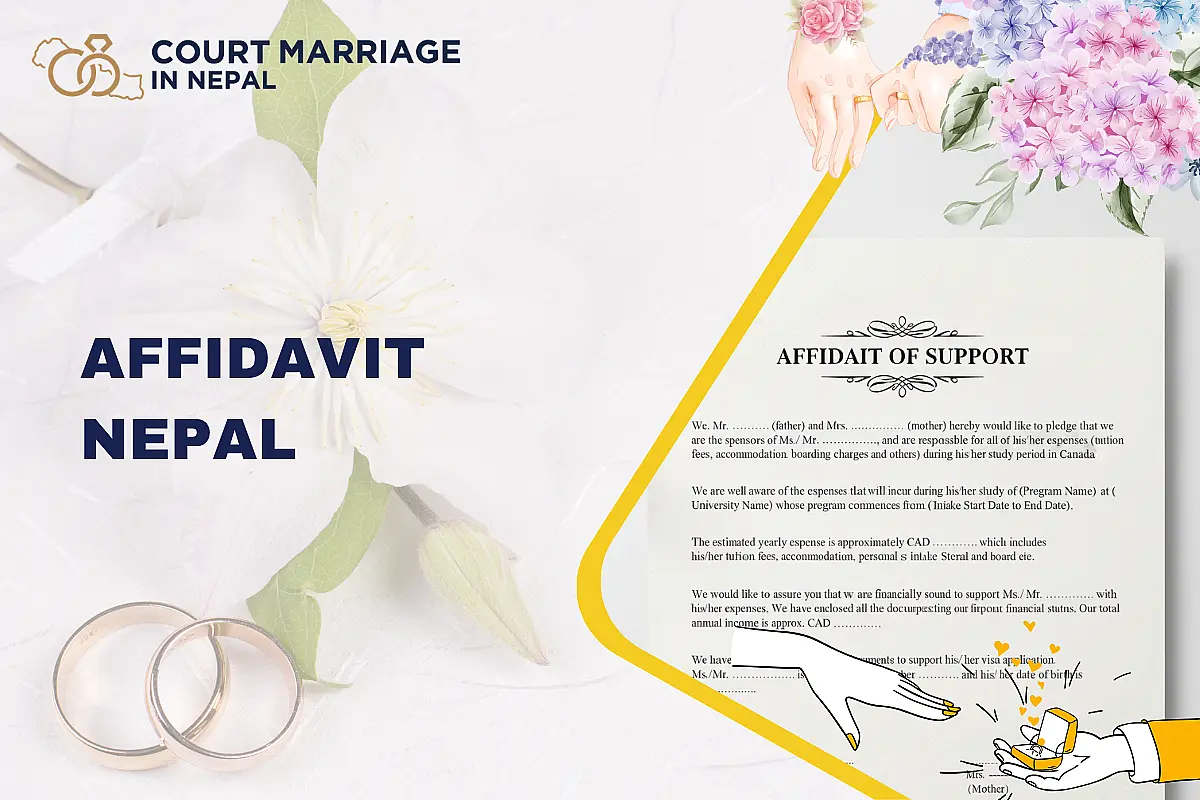
An affidavit (Shapathnama or शपथनामा) is a written sworn statement made voluntarily under oath, used extensively across Nepal's legal, administrative, and personal documentation systems. Whether you need to prove your marital status for a foreign embassy, declare your income for tax purposes, change your name on official records, or submit evidence in a court case, an affidavit is often the required document.
In Nepal, affidavits are governed primarily by the Evidence Act 2031 (1974), the Notary Public Act 2063 (2006), and relevant provisions of the Muluki Civil Code 2074 (2017). A properly executed affidavit must be sworn before a Notary Public or a competent judicial officer and carries legal consequences if any statement within it is found to be false — including criminal prosecution for perjury under the National Penal (Criminal) Code 2074.
Affidavit in Nepal — Key Facts: An affidavit (Shapathnama) is a voluntary sworn statement made under oath before a Notary Public. Common types include single-status affidavits for marriage, name-change affidavits, income-proof affidavits, address-proof affidavits, and court affidavits. Notarization by a licensed Notary Public under the Notary Public Act 2063 is mandatory for legal validity. Making a false statement in an affidavit is punishable as perjury under Section 145 of the National Penal Code 2074, with imprisonment up to three years. Affidavits are widely accepted by courts, government offices, embassies, and financial institutions across Nepal.
Our legal team at court marriage in Nepal regularly drafts, notarizes, and assists clients with various types of affidavits for marriage registration, court proceedings, property matters, and embassy requirements. This guide covers everything you need to know about affidavits in Nepal for 2026.
Need an affidavit drafted or notarized? Contact our legal team for professional assistance with affidavit preparation and notarization.
What Is an Affidavit (Shapathnama)?
An affidavit is a written statement of facts made voluntarily by a person (called the deponent or Shapath Garne Byakti) and confirmed by oath or affirmation before an authorized officer — typically a Notary Public in Nepal. The person making the affidavit swears that the contents are true to the best of their knowledge and belief.
Unlike an ordinary written statement or a declaration, an affidavit carries the force of law. If any statement in the affidavit is later proven to be false, the deponent can face criminal prosecution for perjury under Section 145 of the National Penal (Criminal) Code 2074, which prescribes imprisonment of up to three years.
Affidavits serve several critical legal functions in Nepal:
- Providing sworn evidence in court proceedings without requiring the deponent to appear in person
- Confirming personal facts (identity, address, marital status, income) for government offices and embassies
- Supporting applications for citizenship, passport, and other official documents
- Declaring facts related to property ownership, inheritance, and succession
- Fulfilling documentary requirements for court marriage in Nepal and other marriage registrations
Key Legal Terms
| English Term | Nepali Term | Meaning |
|---|---|---|
| Affidavit | Shapathnama (शपथनामा) | A sworn written statement made under oath |
| Deponent | Shapath Garne Byakti (शपथ गर्ने व्यक्ति) | Person making the affidavit |
| Oath | Shapath (शपथ) | Solemn promise that the statement is true |
| Notary Public | Notary Pawalik (नोटरी पब्लिक) | Officer authorized to administer oaths and authenticate documents |
| Notarization | Notary Pramanikaran (नोटरी प्रमाणीकरण) | Official verification by a Notary Public |
| Perjury | Jhutho Shapath (झुठो शपथ) | Criminal offense of making a false sworn statement |
Legal Framework Governing Affidavits in Nepal
Several laws work together to regulate the creation, authentication, and legal effect of affidavits in Nepal. Understanding this framework helps ensure your affidavit will be accepted by courts and government authorities without challenge.
Notary Public Act 2063 (2006)
This is the primary law governing who can notarize affidavits in Nepal. Under this Act, only licensed Notary Publics appointed by the Government of Nepal can administer oaths and authenticate affidavits. Section 15 of the Act lists the functions of a Notary Public, which include certifying documents, administering oaths, and authenticating signatures. The Act requires Notary Publics to maintain a register of all notarized documents.
Evidence Act 2031 (1974)
The Evidence Act establishes the evidentiary value of affidavits in court proceedings. Section 36 recognizes affidavits as valid evidence when properly executed. Courts may accept affidavit evidence in lieu of oral testimony in certain civil matters, particularly interlocutory applications, bail hearings, and summary proceedings.
National Penal (Criminal) Code 2074 (2017)
Section 145 of the National Penal Code 2074 criminalizes perjury — the act of making a false sworn statement. Any person who knowingly makes a false statement in an affidavit is liable to imprisonment of up to three years. This provision ensures the integrity of the affidavit system.
Muluki Civil Code 2074 (2017)
Various provisions of the Civil Code reference affidavits in connection with marriage registration, property transactions, inheritance claims, and contractual matters. For instance, affidavits are commonly required when proving eligibility for marriage or when claiming inheritance rights in Nepal.
Common Types of Affidavits in Nepal
Different situations require different types of affidavits. Below are the most commonly used types in Nepal, each serving a specific legal or administrative purpose.
Single Status / Marriage Eligibility Affidavit
This is one of the most frequently requested affidavits in Nepal, especially for those planning a court marriage or marrying a foreign national. The deponent swears that they are currently unmarried, not in a subsisting marriage, and legally eligible to marry. Many foreign embassies in Nepal require this affidavit as part of the No Objection Certificate (NOC) process.
This affidavit typically includes:
- Full legal name, date of birth, and citizenship number of the deponent
- Declaration of current unmarried/single status
- Statement that no prior marriage is subsisting
- Father's/mother's name and permanent address
- Purpose for which the affidavit is being made
Name Change Affidavit
When a person's name in one document differs from another — a common issue in Nepal due to spelling variations in English transliterations — a name-change affidavit resolves the discrepancy. This is frequently needed when applying for a Nepal passport or when names on the citizenship certificate differ from academic records.
Income Proof Affidavit
Used to declare annual income when formal documentation is unavailable. This is common among self-employed individuals, farmers, and small business owners who may not have income tax return records. Banks and financial institutions sometimes accept notarized income affidavits for loan processing.
Address Proof Affidavit
Declares the current residential address of the deponent. This is useful when utility bills, rental agreements, or other standard address-proof documents are unavailable or when the address differs from the citizenship certificate. Those with a formal rent agreement may still need this affidavit for certain embassy applications.
Court Affidavit (Judicial Affidavit)
Filed in court proceedings as part of written evidence. Court affidavits are used in civil cases, bail applications, family law matters, and various interlocutory applications. The format must comply with court-specific requirements, and the affidavit must be sworn before the court's designated officer or a Notary Public.
Property-Related Affidavit
Used in land registration and property transactions to declare ownership status, absence of encumbrances, or consent of co-owners. Women exercising property rights may need affidavits when claiming their share under the Muluki Civil Code.
Affidavit for Loss of Documents
When original documents such as citizenship certificates, academic records, or PAN cards are lost or destroyed, a sworn affidavit declaring the loss is typically the first step in obtaining a duplicate. The deponent must describe the circumstances of the loss and declare that the document has not been pledged or handed to another person.
Affidavit for Relationship Proof
Declares the relationship between two persons — parent-child, spouse, sibling, or guardian — when official documentation is insufficient. This is commonly used for visa applications, inheritance claims, and insurance nominee designations.
Affidavit for NRN / Foreign Use
Non-Resident Nepalis (NRNs) and foreign nationals frequently need affidavits for use abroad. These affidavits must be executed before a Nepali Notary Public and may require apostille or embassy attestation for international acceptance. Common purposes include spousal property declarations, power of attorney support documents, and foreign investment compliance affidavits.
Who Can Notarize an Affidavit in Nepal?
Under the Notary Public Act 2063, only the following persons are authorized to administer oaths and notarize affidavits in Nepal:
| Authority | Legal Basis | Scope |
|---|---|---|
| Licensed Notary Public | Notary Public Act 2063, Section 15 | All types of affidavits — most common and widely accepted |
| Court-designated Officer | Court rules and procedures | Court affidavits filed in ongoing cases |
| Nepali Embassy/Consulate | Notary Public Act 2063 (read with diplomatic functions) | Affidavits executed abroad for use in Nepal |
| Chief District Officer (CDO) | Local Administration Act 2028 | Certain government-related affidavits in districts without Notary Public |
Important: A lawyer or advocate alone cannot notarize an affidavit unless they also hold a Notary Public license. Many law firms in Nepal have in-house Notary Publics or close working relationships with licensed notaries. Similarly, a Power of Attorney requires notarization by the same authorized officers.
Where to Get an Affidavit Notarized in Kathmandu
Kathmandu has the highest concentration of licensed Notary Publics in Nepal. You can get your affidavit notarized at the following locations:
- Notary Public offices in Putalisadak and New Baneshwor — These areas have the highest density of law firms and Notary Public offices, making them the most convenient locations for notarization
- District Court premises (Kathmandu, Lalitpur, Bhaktapur) — For court affidavits, you can get notarization at or near the court complex
- Nepal Bar Association building (Ramshah Path) — Several Notary Publics operate within or adjacent to the Bar Association
- Law firms with in-house Notary Public services — Many established law firms offer integrated affidavit drafting and notarization services
Outside Kathmandu: In district headquarters, Notary Public services are typically available near the District Court. In remote areas where Notary Publics are unavailable, the Chief District Officer (CDO) or local judicial bodies may authenticate affidavits. For professional help with affidavit notarization in Nepal, consult a licensed Notary Public or a law firm with dedicated notary services.
Affidavit Format: What Must It Include?
A legally valid affidavit in Nepal must follow a specific format and include all essential elements. An improperly formatted affidavit may be rejected by courts, embassies, or government offices.
Essential Components of an Affidavit
| Component | Description | Required? |
|---|---|---|
| Title / Heading | "Shapathnama" or "Affidavit" — clearly identifying the document type | Yes |
| Court / Authority | Name of court or authority before which the affidavit is submitted | Yes (for court affidavits) |
| Deponent Information | Full name, father's/grandfather's name, age, address, citizenship number | Yes |
| Body of Statement | Numbered paragraphs with facts stated in first person | Yes |
| Verification Clause | "I solemnly declare that the above statements are true to the best of my knowledge and belief" | Yes |
| Oath Clause | Statement that the affidavit is made on oath/solemn affirmation | Yes |
| Date and Place | Date of execution and place where sworn | Yes |
| Deponent's Signature | Signature or thumb impression of the deponent | Yes |
| Notary Seal and Signature | Official seal, signature, and registration number of the Notary Public | Yes |
| Witnesses | Two witnesses with their signatures and identification | Recommended |
Sample Affidavit Structure
While the exact wording varies depending on the purpose, every affidavit in Nepal follows this general structure:
- Header: "SHAPATHNAMA (AFFIDAVIT)" centered at the top
- Addressee: The court, office, or authority to whom it is addressed
- Deponent details: "I, [Full Name], son/daughter of [Father's Name], grandson/granddaughter of [Grandfather's Name], a permanent resident of [District, Municipality/VDC, Ward No.], holder of Citizenship Certificate No. [Number] issued by [District], do hereby solemnly state and declare as follows:"
- Numbered statements: Each fact in a separate numbered paragraph — "1. That I am... 2. That I... 3. That..."
- Verification: "I hereby verify that the contents of this affidavit are true and correct to the best of my knowledge and belief and nothing has been concealed therein."
- Signature block: Deponent's signature, date, and place
- Notary block: "Sworn before me on this [date] day of [month] [year]" — followed by the Notary Public's seal, signature, and registration number
Language: Affidavits for use within Nepal are typically in Nepali. For embassy or international use, bilingual (Nepali and English) affidavits are common. The Notary Public can notarize affidavits in both languages.
Difference Between Affidavit and Declaration
Many people in Nepal confuse affidavits with declarations. While both are written statements of facts, they have significant legal differences:
| Feature | Affidavit (Shapathnama) | Declaration (Ghoshana Patra) |
|---|---|---|
| Oath Requirement | Must be sworn under oath before an authorized officer | No oath required — simply signed by the maker |
| Notarization | Mandatory — must be notarized by Notary Public | Not always required, but recommended |
| Legal Consequence | False statement = perjury (imprisonment up to 3 years) | May lead to civil liability, but not perjury |
| Evidentiary Value | Stronger — accepted as sworn evidence in court | Weaker — treated as an ordinary written statement |
| Use in Court | Can substitute oral testimony in many proceedings | Generally cannot substitute testimony |
| Cost | Higher (includes notarization fee) | Lower (no notarization fee if unnotarized) |
| Common Use | Court proceedings, embassy applications, property matters | Internal records, company matters, informal purposes |
When to use which: Always use a notarized affidavit when submitting to courts, embassies, government offices, or financial institutions. A simple declaration may suffice for internal company records or informal purposes where the law does not specifically require an affidavit.
Using Affidavits for Marriage Registration
Affidavits play a vital role in marriage registration in Nepal, particularly for court marriages and marriages involving foreign nationals. Here are the key affidavit requirements:
For Court Marriage
When registering a court marriage in Nepal, the following affidavits may be required:
- Single status affidavit: Both parties must declare they are not currently married to anyone else
- Age declaration affidavit: Confirming both parties have reached the legal marriage age (20 years under the Muluki Civil Code 2074)
- Consent affidavit: If applicable, an affidavit from parents/guardians providing consent
- Relationship declaration: Affirming the parties are not within the prohibited degrees of relationship
For Marriage with Foreign Nationals
When a Nepali citizen marries a foreign national, additional affidavits are typically required:
- No Objection affidavit: Sworn statement from the foreign party that their home country has no objection to the marriage
- Affidavit of single status from the foreign national: Often required by the District Administration Office alongside the embassy NOC
- Immigration status affidavit: Declaring the visa status and legal entry into Nepal
Affidavit from Abroad (NRN/Foreign)
Non-Resident Nepalis (NRNs) and foreign nationals who need an affidavit for use in Nepal have several options:
Option 1: Nepali Embassy or Consulate
The Nepali Embassy or Consulate in your country of residence can notarize affidavits. This is the most straightforward option, as the embassy acts under authority similar to a Notary Public in Nepal. The affidavit executed at an embassy is generally accepted directly by Nepali courts and government offices.
Option 2: Local Notary + Apostille/Legalization
If a Nepali Embassy is not accessible, you can execute the affidavit before a local Notary Public in your country of residence, then:
- Get the affidavit notarized by a local Notary Public
- Obtain an Apostille (for countries that are members of the Hague Apostille Convention) or legalization from the Ministry of Foreign Affairs of that country
- Have the document authenticated at the nearest Nepali Embassy
- Submit the authenticated document in Nepal
This process is identical to the authentication required for a Power of Attorney executed abroad.
Option 3: Authorized Representative in Nepal
If you have already executed a Power of Attorney authorizing someone in Nepal to act on your behalf, your agent may be able to execute certain affidavits on your behalf — but this depends on the nature of the affidavit and the scope of the PoA. Personal-knowledge affidavits (e.g., declaring your marital status) generally cannot be made through an agent.
Planning to execute an affidavit from abroad? Contact our legal team — we assist NRNs and foreign nationals with remote affidavit preparation, embassy coordination, and document authentication.
Cost of Affidavit Notarization in Nepal
The cost of preparing and notarizing an affidavit in Nepal varies depending on the complexity and purpose. Here is a general overview:
| Service | Typical Range | Notes |
|---|---|---|
| Notarization fee (Notary Public) | NPR 500 – 2,000 | Set by government schedule; varies by document type |
| Drafting fee (if using a lawyer) | NPR 1,000 – 5,000 | Depends on complexity; simple affidavits cost less |
| Translation fee (bilingual) | NPR 500 – 2,000 | For Nepali-English bilingual affidavits |
| Embassy notarization (abroad) | Varies by embassy | Check with your nearest Nepali Embassy for current fees |
| Apostille/Legalization (abroad) | Varies by country | Additional cost for international authentication |
Note: Government notarization fees are regulated under the Notary Public Act 2063 and related rules. However, the drafting fee charged by lawyers is market-driven and varies by firm and complexity.
Step-by-Step Process to Get an Affidavit in Nepal
Follow these steps to prepare and notarize your affidavit in Nepal:
Step 1: Determine the Type and Purpose
Identify exactly what type of affidavit you need and for which authority. Different courts, embassies, and government offices may have specific format requirements. If unsure, consult a lawyer or the office where you will be submitting the affidavit.
Step 2: Gather Required Documents
Prepare all supporting documents that will be referenced in or attached to the affidavit:
- Citizenship certificate (original and photocopy)
- National ID card or passport
- Any documents relevant to the subject matter (property papers, marriage certificate, academic records, etc.)
- Passport-size photographs (some Notary Publics require these)
Step 3: Draft the Affidavit
Draft the affidavit yourself or have a lawyer draft it for you. Ensure it follows the proper format described above — numbered paragraphs, verification clause, and oath clause. For court affidavits, check if the court has a prescribed format.
Step 4: Visit the Notary Public
Take the drafted affidavit and all supporting documents to a licensed Notary Public. The deponent must appear in person — the Notary Public will:
- Verify the deponent's identity using the citizenship certificate
- Read through the affidavit to ensure it is properly worded
- Administer the oath — the deponent swears that the contents are true
- Affix the official Notary seal, sign the document, and record it in the notary register
Step 5: Collect and Submit
After notarization, collect the original affidavit with the Notary seal. Make photocopies for your records. Submit the original to the court, embassy, or government office as required.
Common Mistakes to Avoid When Making an Affidavit
Based on our experience handling thousands of affidavits, here are the most common mistakes that lead to rejection:
- Vague or ambiguous statements: Every fact must be stated clearly and specifically. Avoid general statements like "I have property" — specify the exact details
- Missing verification clause: The verification clause is legally required. An affidavit without it may be rejected
- Incorrect personal details: Ensure your name, father's name, and citizenship number match your official documents exactly
- Unsigned or improperly signed: The deponent must sign every page (not just the last page) in the presence of the Notary Public
- Outdated information: If referencing dates, addresses, or legal provisions, ensure all information is current
- No Notary seal: An affidavit without the official Notary Public seal and registration number has no legal effect
- Using an unauthorized person: Only licensed Notary Publics and other authorized officers can notarize affidavits. Having a random lawyer "stamp" it is not valid
- Making false statements: This is not just a mistake — it is a criminal offense under Section 145 of the National Penal Code 2074
How Long Is an Affidavit Valid in Nepal?
There is no universal expiry date for affidavits under Nepali law. However, the practical validity depends on the purpose:
- Embassy and visa affidavits: Most embassies accept affidavits that are less than 3–6 months old
- Court affidavits: Valid for the duration of the case unless circumstances change
- Government office affidavits: Typically accepted if less than 6 months old, though some offices may accept older affidavits
- Property affidavits: Usually valid until the transaction is completed, but the receiving office may request a fresh one if significant time has passed
Best practice: Get a fresh affidavit if the previous one is more than 3 months old, unless the receiving authority specifically states otherwise.
Have questions about affidavit requirements for your specific situation? Reach out to our legal experts for personalized guidance on affidavit preparation and notarization in Nepal.
Frequently Asked Questions
An affidavit (Shapathnama) is a written sworn statement made voluntarily under oath before a licensed Notary Public or authorized officer in Nepal. It carries legal force under the Evidence Act 2031 and Notary Public Act 2063. Making a false statement in an affidavit constitutes perjury under Section 145 of the National Penal Code 2074, punishable by up to three years of imprisonment.
Only licensed Notary Publics appointed under the Notary Public Act 2063, court-designated officers for judicial affidavits, Nepali Embassy or Consulate officials for affidavits executed abroad, and Chief District Officers in areas without a Notary Public can notarize affidavits in Nepal. An ordinary lawyer without a Notary Public license cannot notarize an affidavit.
Notarization fees set by the government typically range from NPR 500 to NPR 2,000 depending on the document type. If you hire a lawyer to draft the affidavit, expect an additional NPR 1,000 to NPR 5,000. Bilingual affidavits (Nepali and English) may cost extra for translation services.
You need your original citizenship certificate and a photocopy, passport-size photographs (some Notary Publics require these), and any supporting documents relevant to the affidavit's subject matter such as property papers, marriage certificates, or academic records. The deponent must appear in person before the Notary Public.
Yes. While most affidavits in Nepal are in Nepali, bilingual affidavits (Nepali and English) are commonly prepared for embassy applications, foreign marriage registrations, and international use. The Notary Public can notarize affidavits in both Nepali and English. Some embassies specifically require English-language affidavits.
An affidavit is a sworn statement made under oath before an authorized officer and carries perjury consequences if false. A declaration (Ghoshana Patra) is a written statement signed by the maker without requiring an oath or notarization. Affidavits have stronger evidentiary value in court and are required by courts, embassies, and government offices.
Yes. For court marriage in Nepal, both parties typically need a single-status affidavit declaring they are unmarried and legally eligible to marry. Additional affidavits regarding age, consent, and relationship may be required depending on the circumstances of the marriage.
There is no fixed legal expiry for affidavits under Nepali law. However, most embassies and government offices accept affidavits that are less than 3 to 6 months old. Court affidavits remain valid for the duration of the case. It is advisable to get a fresh affidavit if the previous one is more than 3 months old.
Yes. You can execute an affidavit at the nearest Nepali Embassy or Consulate, which acts with Notary Public authority. Alternatively, you can get the affidavit notarized locally, apostilled or legalized by the foreign ministry, and authenticated at a Nepali Embassy. A Power of Attorney holder in Nepal may execute certain affidavits on your behalf.
Making a false sworn statement in an affidavit constitutes perjury under Section 145 of the National Penal Code 2074. The penalty is imprisonment of up to three years. Additionally, any legal proceeding or transaction based on the false affidavit may be invalidated by the court.
Kathmandu has numerous Notary Public offices concentrated in Putalisadak, New Baneshwor, and near the District Court premises. The Nepal Bar Association building in Ramshah Path also has Notary Publics nearby. Many law firms offer integrated affidavit drafting and notarization services for convenience.
Yes. Under the Evidence Act 2031, properly notarized affidavits are admissible as evidence in court proceedings. Courts may accept affidavit evidence in lieu of oral testimony in civil matters, interlocutory applications, and bail hearings. However, the opposing party may request cross-examination of the deponent in some cases.
Yes. When your name differs across official documents due to spelling variations — common in English transliterations of Nepali names — a notarized name-change affidavit resolves the discrepancy. This is frequently needed for passport applications, bank account changes, and academic record corrections.
A valid Nepali affidavit must include a title (Shapathnama), deponent's full details including citizenship number, numbered paragraphs stating facts in first person, a verification clause declaring the contents are true, an oath clause, the deponent's signature, date and place, and the Notary Public's seal, signature, and registration number.
Yes. Foreign nationals can make affidavits in Nepal before a licensed Notary Public. They must present their passport as identification instead of a citizenship certificate. For marriage-related affidavits, foreign nationals often need to provide additional documentation from their embassy, such as a No Objection Certificate or single-status letter.
Court Marriage in Nepal Pvt. Ltd. is Nepal's first registered law firm for court marriage services. Since 2016, our Nepal Bar Council-registered advocates have helped 2,000+ couples from 50+ countries with marriage registration, document preparation, and legal consultation. Whether you are a Nepali citizen or a foreign national, contact us today for confidential legal assistance.