Table of Contents
- What Is a Death Certificate in Nepal?
- Who Must Register a Death?
- Where to Register a Death
- Documents Required for Death Registration
- Step-by-Step Death Registration Process
- Timeline and Fees
- Death Certificate for Inheritance Purposes
- Death Certificate for Use Abroad
- How to Get a Duplicate Death Certificate
- Common Mistakes to Avoid
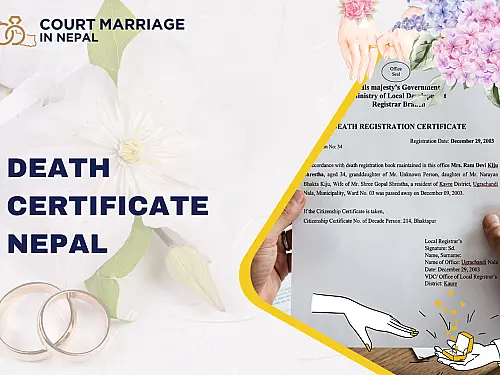
A death certificate (Mrityu Darta Praman Patra or मृत्यु दर्ता प्रमाण पत्र) is a legal document issued by the local government that officially records the death of a person in Nepal. Death registration and the issuance of a death certificate are governed by the Birth, Death and Other Personal Events (Registration) Act 2033 (1976) and the Local Government Operation Act 2074 (2017), which delegates vital registration duties to ward offices across Nepal.
As of April 2026, death registration remains one of the most underreported vital events in Nepal, with many families unaware that a death certificate is legally required within 35 days of the death. This document is essential for settling inheritance, claiming insurance, transferring property, and for use abroad. This guide covers everything you need to know about obtaining a death certificate in Nepal.
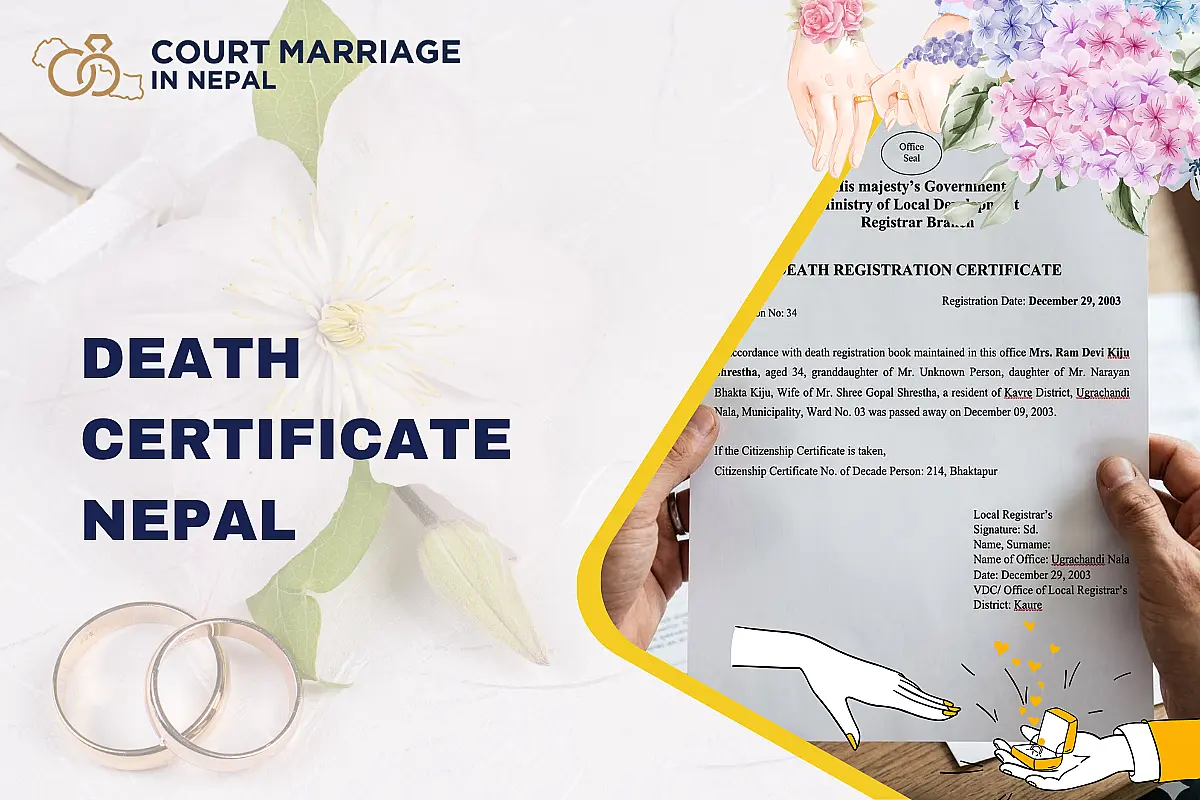
Death certificate in Nepal is issued by the local ward office where the death occurred or where the deceased last resided. Under the Birth, Death and Other Personal Events (Registration) Act 2033, death must be registered within 35 days. The process requires a citizenship certificate, medical report or witness statement, and a small government fee typically under NPR 100.
Trusted by 2,000+ couples from 50+ countries since 2016.
Speak with a court marriage lawyer today →
What Is a Death Certificate in Nepal?
A death certificate is the official government record confirming that a person has died. It contains the name of the deceased, date and place of death, cause of death (if medically determined), and the name of the informant who reported the death. In Nepal, the certificate is issued by the ward office (formerly VDC or municipality office) under the authority of the local government.
The legal basis for death registration is Section 4 of the Birth, Death and Other Personal Events (Registration) Act 2033, which mandates the registration of deaths along with births, marriages, divorces, and migrations. The Local Government Operation Act 2074 further assigns vital event registration as a core function of local governments, making the ward chairperson or designated registrar responsible for issuing death certificates.
Death registration is distinct from a post-mortem examination. A death certificate from the ward office is a civil registration document, while a post-mortem report is a medical-legal document issued by a hospital or government doctor. Both may be needed in cases of unnatural death.
Who Must Register a Death?
Under Section 5 of the Birth, Death and Other Personal Events (Registration) Act 2033, the following persons are legally responsible for reporting a death to the local registrar:
- Family members: The head of the household or the nearest relative of the deceased has the primary obligation to register the death
- Hospital or institution: If the death occurs in a hospital, prison, hostel, or similar institution, the head of that institution must report it
- Person present at death: If no family member or institutional head is available, any person present at the time of death or who discovers the body
- Local authority: In cases where no one else reports the death, the local ward office may register it based on information from neighbors or community members
Failure to register a death within the prescribed period can result in a late registration fee and may complicate legal matters such as inheritance claims and property transfers.
Where to Register a Death
Deaths in Nepal are registered at the ward office of the local government (Gaunpalika or Nagarpalika) where the death occurred or where the deceased was a permanent resident. Under the Local Government Operation Act 2074, each of Nepal's 753 local governments operates ward-level offices that handle vital registrations including birth, death, marriage, and migration.
If the death occurred in a different district from the deceased's permanent residence, the family can register the death at either location. However, for vital registration consistency, it is advisable to register at the ward office of the deceased's permanent address, as this links to other records such as citizenship and land ownership.
For deaths that occur abroad, the nearest Nepal Embassy or Consulate can assist with documentation, but the death must still be registered at the home ward office in Nepal using authenticated documents from the country where the death occurred.
Documents Required for Death Registration
The following documents are required when registering a death at the ward office.
| Document | Details |
|---|---|
| Citizenship certificate of the deceased | Original and photocopy (both sides) |
| Citizenship certificate of the informant | The person reporting the death must present their own citizenship |
| Medical certificate or hospital death report | If the death occurred in a hospital; states cause of death |
| Death registration application form | Available at the ward office, filled by the informant |
| Two passport-size photographs of the deceased | If available; not always mandatory |
| Police report (if applicable) | Required for unnatural deaths, accidents, or unknown cause of death |
| Witness statement | If no medical certificate is available, a statement from a witness or community leader |
In many rural areas, deaths occur outside hospitals and no medical certificate is available. In such cases, the ward office accepts a statement from a local witness or the ward member confirming the death. This practice is recognized under the Act to ensure registration is not hindered by lack of medical documentation.
Step-by-Step Death Registration Process
The death registration process in Nepal is relatively straightforward when done within the prescribed time limit. Here is the complete process as of 2083 BS (2026 AD).
Step 1: Gather Documents
Collect the citizenship certificate of the deceased, your own citizenship certificate as the informant, and any medical or hospital documents related to the death. If the death was unnatural, obtain the police report first.
Step 2: Visit the Ward Office
Go to the ward office of the local government where the death occurred or where the deceased permanently resided. Request the death registration form (Mrityu Darta Form). Some municipalities now offer online form downloads through their websites.
Step 3: Fill the Application Form
Complete the form with details including the full name of the deceased, date of death, place of death, cause of death, and the relationship of the informant to the deceased. The form must be signed by the informant.
Step 4: Submit and Pay Fee
Submit the completed form along with all supporting documents to the ward registrar. Pay the registration fee, which is nominal for registrations within 35 days. Late registrations incur an additional fee.
Step 5: Receive the Death Certificate
The ward registrar verifies the documents and issues the death certificate. In most ward offices, the certificate is issued on the same day or within 1 to 3 working days. The certificate is signed by the ward chairperson or the designated registrar and carries the official seal of the local government.
From our experience assisting families with legal documentation after the death of a family member, we have seen that delays almost always occur because the informant does not bring the deceased's citizenship certificate or because no medical report is available. Preparing these documents in advance significantly speeds up the process.
Timeline and Fees
The timeline and fees for death registration depend on how promptly the death is reported after it occurs.
| Registration Timing | Fee (Approximate) | Processing Time |
|---|---|---|
| Within 35 days of death | Free to NPR 50 | Same day to 3 working days |
| After 35 days (late registration) | NPR 50 to NPR 200 | 3 to 7 working days |
| After 1 year (very late) | NPR 100 to NPR 500 (varies by municipality) | May require additional verification |
| Duplicate certificate | NPR 50 to NPR 100 | Same day to 3 working days |
Under Section 6 of the Birth, Death and Other Personal Events (Registration) Act 2033, the prescribed period for registering a death is 35 days from the date of death. Registration within this period is either free or subject to a minimal fee depending on the local government's schedule. Late registration is still possible but may require additional documentation and a higher fee.
Fees vary slightly between municipalities and rural municipalities (Gaunpalikas), as the Local Government Operation Act 2074 grants local governments the authority to set their own service charge schedules.
Death Certificate for Inheritance Purposes
A death certificate is one of the most critical documents for settling inheritance matters in Nepal. Under the National Civil Code 2074 (Muluki Dewani Samhita), the legal heirs of a deceased person cannot initiate property transfer, claim bank deposits, or settle estate matters without a registered death certificate.
Why It Matters for Inheritance
- Property transfer: The Land Revenue Office requires a death certificate to transfer land ownership from the deceased to the legal heirs
- Bank accounts: Banks require a death certificate along with a succession certificate or court order to release funds from the deceased's accounts
- Insurance claims: Life insurance companies require the death certificate as primary proof before processing any claim
- Pension and gratuity: Government and private employers require a death certificate to process pension, gratuity, or provident fund payments to the family of a deceased employee
- Legal disputes: In cases of disputed inheritance, the death certificate serves as the foundational document establishing the date and fact of death
Married couples should understand that under the National Civil Code 2074, a surviving spouse is among the first-class heirs entitled to an equal share of the deceased's property. Without a death certificate, the surviving spouse cannot legally claim their rightful share. Couples involved in court marriage in Nepal should be aware that the marriage certificate combined with the death certificate forms the basis for spousal inheritance claims.
Death Certificate for Use Abroad
If you need to use a Nepali death certificate in a foreign country, the document must go through an authentication process. This is commonly required for insurance claims filed abroad, immigration matters, social security claims, or property transfers in another country.
Authentication Process
- Notarization: Get the death certificate notarized by a government-authorized notary public in Nepal
- Ministry of Foreign Affairs (MoFA): Submit the notarized document to the Department of Consular Services, Tripureshwor for MoFA attestation. Nepal is not a member of the Hague Apostille Convention, so the traditional attestation route applies
- Embassy attestation: After MoFA attestation, the document must be attested by the relevant destination country's embassy or consulate in Kathmandu
Translation into English or the language of the destination country may also be required. Authorized translators in Kathmandu can provide certified translations that are accepted by MoFA for authentication.
Need help authenticating a death certificate for use abroad? Contact our legal team for notarization, MoFA attestation, and embassy legalization services.
How to Get a Duplicate Death Certificate
If the original death certificate is lost, damaged, or additional copies are needed, you can apply for a duplicate from the same ward office that issued the original certificate.
Requirements for a Duplicate Certificate
- Application letter addressed to the ward chairperson stating the reason for the duplicate
- Citizenship certificate of the applicant
- Any available copy of the original certificate (if partially damaged)
- Payment of the duplicate issuance fee (typically NPR 50 to NPR 100)
The ward office maintains a register of all vital events, so as long as the death was previously registered, issuing a duplicate is a routine process. The duplicate certificate carries the same legal validity as the original. In cases where the ward office records have been destroyed or lost, the applicant may need to provide additional evidence such as newspaper notices or witness statements.
Common Mistakes to Avoid
Based on common issues we encounter when assisting families with death-related legal documentation, here are the most frequent mistakes to avoid:
- Missing the 35-day deadline: Many families delay registration during the mourning period and then face late fees and additional documentation requirements. Register as soon as possible
- Not obtaining a medical certificate: If the death occurs in a hospital, always request the hospital death report before discharge of the body. It is much harder to obtain later
- Wrong ward office: Ensure you go to the correct ward office. Registering at the wrong ward can cause complications for future property and inheritance matters
- Incomplete informant details: The informant must clearly state their relationship to the deceased. Vague or incorrect relationships can delay processing
- Not keeping multiple copies: Always request at least two to three certified copies of the death certificate. Banks, insurance companies, and the Land Revenue Office each require their own copy
- Ignoring foreign authentication needs: If the deceased had assets or family abroad, start the apostille process early. MoFA authentication can take additional time
Need assistance with death registration, inheritance claims, or legal documentation? Contact our experienced legal team for professional guidance through every step of the process.
Frequently Asked Questions
A death certificate is an official document issued by the ward office confirming the death of a person in Nepal. It is required for inheritance, property transfer, insurance claims, and bank account settlements.
Death registration typically takes the same day to three working days at the ward office if all documents are complete. Late registrations after 35 days may take up to seven working days due to additional verification requirements by the registrar.
Yes. Under Section 4 of the Birth, Death and Other Personal Events (Registration) Act 2033, death registration is mandatory. The death must be reported to the local ward office within 35 days. Failure to register can result in late fees and complications in inheritance and property matters.
You need the citizenship certificate of the deceased, citizenship certificate of the informant, a medical certificate or hospital death report (if available), the death registration form from the ward office, and a police report if the death was unnatural.
Death registration within 35 days is free or costs up to NPR 50 depending on the municipality. Late registration fees range from NPR 50 to NPR 500. Duplicate certificates cost NPR 50 to NPR 100. Fees vary by local government under the Local Government Operation Act 2074.
The head of the household or nearest relative has the primary obligation. If the death occurred in a hospital or institution, the institution head must report it. Any person present at the time of death or who discovers the body can also register the death at the ward office.
Under Section 6 of the Birth, Death and Other Personal Events (Registration) Act 2033, a death must be registered within 35 days. Late registration is still possible but incurs additional fees and may require extra documentation such as witness statements or community leader verification.
Register at the ward office of the local government (Gaunpalika or Nagarpalika) where the death occurred or where the deceased permanently resided. Nepal has 753 local governments, each with ward offices that handle vital event registrations including death.
Yes. If a Nepali citizen dies abroad, the death must still be registered at the home ward office in Nepal. You need authenticated documents from the country where the death occurred, typically including a death certificate from that country, translated and attested by the Nepal Embassy.
Yes. Under the National Civil Code 2074, legal heirs cannot transfer property, access bank accounts, or claim insurance without a registered death certificate. The Land Revenue Office, banks, and insurance companies all require the original or a certified copy before processing any claims.
Apply at the same ward office that issued the original certificate. Submit an application letter to the ward chairperson, your citizenship certificate, and pay the duplicate fee of NPR 50 to NPR 100. The ward office issues duplicates from their vital events register.
No. For use in foreign countries, a Nepali death certificate must be authenticated through MoFA attestation at the Department of Consular Services, Tripureshwor, Kathmandu. Nepal is not a member of the Hague Apostille Convention, so embassy attestation is typically also required after MoFA authentication.
Unregistered deaths create serious legal complications. The family cannot transfer property, claim insurance, access bank accounts, or settle the estate of the deceased. Late registration incurs additional fees and may require witness statements and verification by the ward office.
A police report is required only for unnatural deaths including accidents, suicides, or deaths of unknown cause. For natural deaths with a hospital medical certificate or a credible witness statement, no police report is necessary for registration at the ward office.
Yes. If there are errors in the death certificate, the informant can apply for correction at the issuing ward office. You must provide supporting documents proving the correct information. The ward registrar can make corrections in the vital events register and issue a corrected certificate.
Court Marriage in Nepal Pvt. Ltd. is Nepal's first registered law firm for court marriage services. Since 2016, our Nepal Bar Council-registered advocates have helped 2,000+ couples from 50+ countries with marriage registration, document preparation, and legal consultation. Whether you are a Nepali citizen or a foreign national, contact us today for confidential legal assistance.