Table of Contents
- What Is an Affidavit of Eligibility to Marry?
- Why Nepal Requires This Document
- What the Affidavit Must Contain
- Country-by-Country Guide to Obtaining the Affidavit
- What to Do When Your Embassy Does Not Issue an Affidavit
- Documents Needed to Obtain the Affidavit
- Translation and Legalisation Requirements
- How the Affidavit Fits Into the Court Marriage Process
- Validity Period of the Affidavit
- Common Mistakes to Avoid
If you are a foreign national planning a court marriage in Nepal, one document sits at the centre of your entire application: the affidavit of eligibility to marry. Without it, Nepal's District Court will not accept your 15-day marriage notice. Known by different names in different countries — affidavit of marital status, certificate of no impediment (CNI), or single status declaration — this sworn statement confirms you are legally free to marry. As of April 2026, every foreigner marrying in Nepal under the Muluki Civil Code 2074 must present this document alongside their other paperwork. This guide walks you through exactly how to obtain one, country by country, and what to do if your embassy does not issue it.
An affidavit of eligibility to marry in Nepal is a sworn legal document from your embassy or consulate confirming you are not currently married and have no legal impediment to marriage. Nepal's District Court requires this from every foreign national as part of the court marriage application. Processing takes 1–5 working days depending on your embassy, and the document is typically valid for 3–6 months.
Trusted by 2,000+ couples from 50+ countries since 2016.
Speak with a court marriage lawyer today →
What Is an Affidavit of Eligibility to Marry?
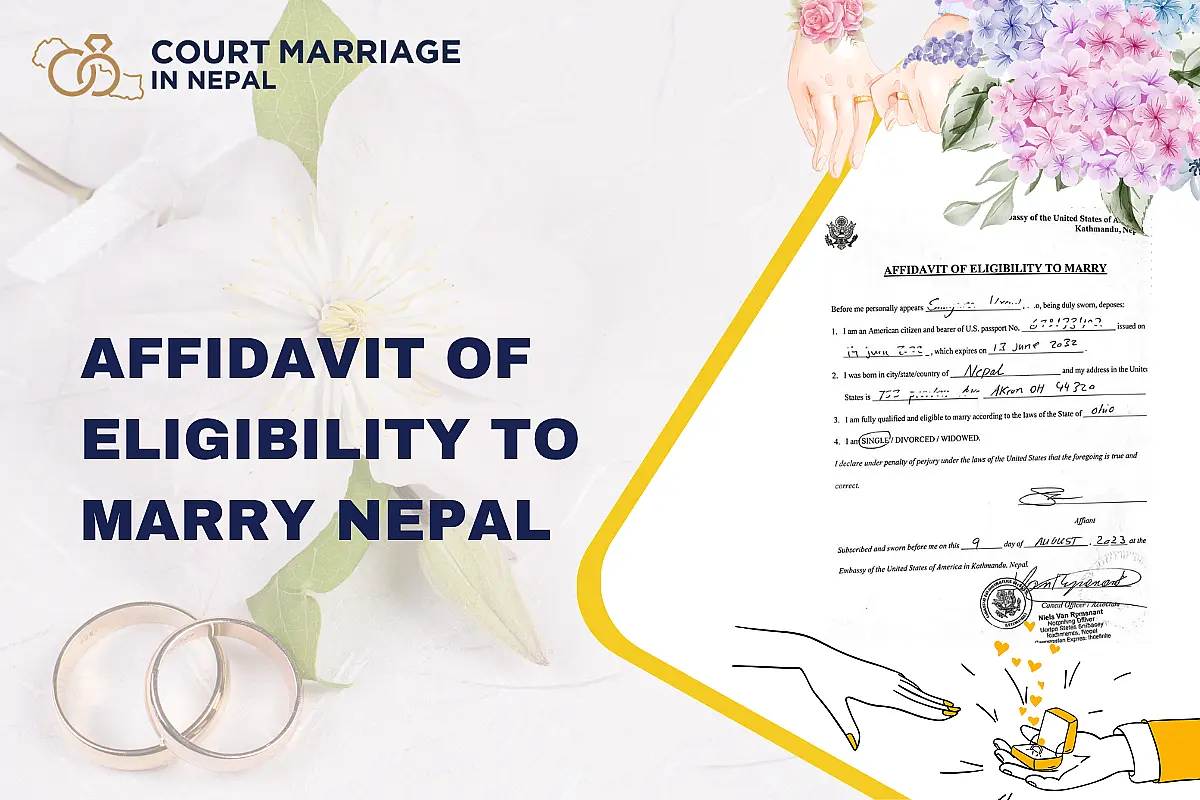
An affidavit of eligibility to marry is a sworn legal declaration stating that you are legally free to enter into marriage. It confirms that you are not currently married, not in a civil partnership, and that no legal barrier exists under your home country's law that would prevent your marriage in Nepal.
This document goes by several names depending on your nationality:
| Country | Document Name |
|---|---|
| United States | Affidavit of Marital Status / Affidavit of Single Status |
| United Kingdom | Certificate of No Impediment (CNI) |
| Canada | Affidavit of Single Status / Statutory Declaration |
| Australia | Certificate of No Impediment (CNI) |
| India | No Objection Certificate (NOC) / Affidavit of Eligibility |
| Germany | Ehefähigkeitszeugnis (Certificate of Capacity to Marry) |
| France | Certificat de Capacité Matrimoniale / Certificat de Coutume |
| Japan | Kon-in Yoken Gubi Shomeisho (Certificate of Legal Capacity to Contract Marriage) |
| South Korea | Honin Gwanye Jeongseo (Affidavit of Eligibility to Marry) |
Regardless of the name, the purpose is identical: to satisfy Nepal's legal requirement that the foreign spouse has no existing marriage or legal impediment. The Muluki Civil Code 2074, Part 3, Section 70 sets four conditions for a valid marriage, including that neither party is already married to someone else.
Why Nepal Requires This Document
Nepal's marriage law under the Muluki Civil Code 2074 (Part 3, Sections 67–84) requires every marriage to meet specific conditions. Section 70 lists four mandatory conditions, one of which is that neither party has an existing undissolved marriage. For Nepali citizens, the court can verify marital status through citizenship records and local government databases. For foreigners, no such verification is possible — so the court relies on your embassy's affidavit as proof.
The affidavit is submitted as part of the 15-day public notice application at the District Court. Without it, the court registrar will reject your application outright. In our experience handling over 2,000 international marriages, this document causes more delays than any other — usually because couples wait until they arrive in Nepal to start the process.
Affidavit vs No Objection Certificate (NOC)
Some embassies issue what they call a No Objection Certificate (NOC) rather than an affidavit. Functionally, these serve the same purpose — confirming you are free to marry. Nepal's District Court accepts both. The key difference is terminology, not substance. For a detailed guide on NOCs, see our article on No Objection Certificates for marriage in Nepal.
What the Affidavit Must Contain
While the exact format varies by embassy, Nepal's District Court expects the affidavit to include:
- Full legal name — exactly as it appears on your passport
- Date of birth and place of birth
- Nationality and passport number
- Current marital status — statement that you are single, divorced, or widowed
- Declaration of no legal impediment — confirmation that no law of your home country prevents your marriage
- Name of intended spouse (some embassies include this, others do not)
- Signature of consular officer or notarial seal
If you have been previously married, the affidavit must also reference your divorce decree or death certificate of your former spouse. Some embassies require you to present these documents before they will issue the affidavit.
Country-by-Country Guide to Obtaining the Affidavit
Each embassy follows its own process. Below is what we have seen work for nationals of the most common countries in our practice. As of April 2026, these reflect current procedures — but always confirm directly with your embassy, as requirements can change.
United States
The US Embassy in Kathmandu issues an "Affidavit of Marital Status" (sometimes called an Affidavit of Single Status). The US government does not issue a central "certificate" of unmarried status, so the embassy provides a notarised affidavit instead.
- Process: Schedule an appointment at the US Embassy Consular Section. You will swear the affidavit before a consular officer.
- Documents needed: Valid US passport, proof of address, and divorce decree or death certificate if previously married.
- Processing time: Same day (appointment required).
- Validity: Typically accepted for 3–6 months from date of issuance.
United Kingdom
The UK issues a Certificate of No Impediment (CNI). Unlike many countries, the CNI process begins in the UK, not at the embassy in Nepal.
- Process: Give notice of marriage at your local register office in England or Wales (or equivalent in Scotland/Northern Ireland). After a 28-day waiting period, the register office issues the CNI. You then have it legalised by the Foreign, Commonwealth and Development Office (FCDO) for use in Nepal.
- Documents needed: Passport, proof of address, details of your intended spouse.
- Processing time: 28 days (notice period) plus 5–10 working days for FCDO legalisation.
- Validity: 3 months from date of issue.
- Important: Since Nepal is not a member of the Hague Apostille Convention, the full legalisation chain is required — FCDO legalisation followed by attestation at the Nepali Embassy in London.
Canada
Canada does not issue a single federal document confirming unmarried status. Instead, Canadians typically obtain a Statutory Declaration of Single Status or an affidavit sworn before a consular officer.
- Process: Visit the Canadian Embassy or nearest consulate in Nepal. Swear a statutory declaration before the consular officer.
- Documents needed: Valid Canadian passport, any previous divorce decrees or death certificates.
- Processing time: 1–2 working days.
- Validity: 6 months from date of issuance.
Australia
The Australian Embassy issues a Certificate of No Impediment (CNI) for Australians marrying abroad.
- Process: Complete the CNI application form (available on the embassy website) and submit it in person or by post to the nearest Australian diplomatic mission.
- Documents needed: Australian passport, statutory declaration of single status, divorce decree or death certificate if applicable.
- Processing time: 2–5 working days.
- Validity: 6 months from date of issuance.
India
Indian nationals typically obtain an NOC or affidavit from the Indian Embassy in Kathmandu. India is the most common nationality for foreign spouses in Nepal, and the process is well established.
- Process: Apply at the Indian Embassy in Kathmandu with supporting documents. The embassy may also accept an affidavit sworn before a notary in India, authenticated by the Ministry of External Affairs (MEA).
- Documents needed: Indian passport, Aadhaar card or voter ID, divorce decree if previously married, two passport-size photos.
- Processing time: 2–5 working days at the embassy.
- Validity: 3–6 months.
For more on Indian nationals marrying in Nepal, see our guide on documents required for court marriage in Nepal.
Germany
Germany issues an Ehefähigkeitszeugnis (Certificate of Capacity to Marry), which is one of the most thorough documents of its kind. It is issued by the Standesamt (civil registry office) in Germany.
- Process: Apply at your local Standesamt in Germany. You must provide documents from your intended Nepali spouse as well. The Standesamt verifies everything before issuing the certificate.
- Documents needed: Birth certificate, passport, certificate of registration, proof of single status, and documents from your Nepali partner (translated into German by a certified translator).
- Processing time: 2–8 weeks (this is among the longest of any country).
- Validity: 6 months from date of issuance.
- Important: The Ehefähigkeitszeugnis must be legalised through the full chain since Nepal is not a Hague Apostille Convention member.
France
French nationals need a Certificat de Capacité Matrimoniale (Certificate of Matrimonial Capacity) or a Certificat de Coutume from the French Embassy.
- Process: Apply at the French Embassy or Consulate. France requires publishing marriage banns (a public notice) before issuing the certificate.
- Documents needed: French passport, birth certificate (less than 3 months old), proof of single status, details of intended spouse.
- Processing time: 3–6 weeks (includes mandatory publication period).
- Validity: 3 months.
Japan
Japanese nationals obtain a Kon-in Yoken Gubi Shomeisho (Certificate of Legal Capacity to Contract Marriage) from the Japanese Embassy.
- Process: Visit the Japanese Embassy in Kathmandu with required documents. The embassy issues the certificate based on your koseki tohon (family register).
- Documents needed: Japanese passport, koseki tohon (family register extract, issued within 3 months), divorce certificate if applicable.
- Processing time: 1–3 working days.
- Validity: 3 months.
South Korea
South Korean nationals obtain an affidavit of eligibility to marry from the Korean Embassy in Kathmandu, supported by a certificate of family relations from Korea.
- Process: Apply at the Korean Embassy with your family relations certificate and passport.
- Documents needed: Korean passport, certificate of family relations (issued within 3 months), divorce certificate if applicable.
- Processing time: 1–3 working days.
- Validity: 3–6 months.
What to Do When Your Embassy Does Not Issue an Affidavit
Not every embassy issues an affidavit of eligibility or CNI. Some countries — particularly smaller nations without an embassy in Kathmandu — have no formal process for this document. In our practice, we have seen this situation many times and there are workable alternatives.
If your embassy cannot or does not issue an affidavit, you can:
- Swear a statement before a Nepal notary public: A licensed Nepali notary can administer an oath and notarise your sworn declaration of single status. This must include all the same information the court requires (full name, nationality, marital status, no legal impediment). Notary Nepal provides this service for foreign nationals.
- Obtain a letter from your embassy: Even if your embassy does not issue a formal affidavit, many will provide a letter confirming that they do not issue such documents — which the court may accept alongside your notarised sworn statement.
- Obtain a single status certificate from your home country: Some countries issue these through local government offices or civil registries. Have it legalised and translated into English before bringing it to Nepal.
In all cases, consult with a lawyer before your court date to confirm what combination of documents the District Court in your jurisdiction will accept. Requirements can vary slightly between courts.
Need help with your affidavit? Our lawyers guide foreign nationals through this process every week →
Documents Needed to Obtain the Affidavit
While requirements vary by embassy, the following documents are commonly requested when applying for an affidavit of eligibility:
| Document | Details |
|---|---|
| Valid passport | Must have at least 6 months validity remaining |
| Passport-size photographs | 2–4 photos (white background, recent) |
| Proof of current address | Utility bill, bank statement, or government-issued ID |
| Divorce decree (if previously married) | Final decree absolute — certified copy with court seal |
| Death certificate of former spouse (if widowed) | Certified copy issued by relevant authority |
| Single status certificate from home country | Some embassies require this as a supporting document |
| Details of intended spouse | Full name, date of birth, nationality of your Nepali partner |
We strongly recommend preparing all documents before travelling to Nepal. Waiting until arrival often causes delays of days or even weeks.
Translation and Legalisation Requirements
Nepal's District Court accepts documents in English or Nepali. If your affidavit is issued in any other language — German, French, Japanese, Korean, or any other — it must be translated into English by a certified translator, and the translation must be notarised.
Legalisation Chain for Non-Apostille Countries
Nepal is not a member of the Hague Apostille Convention. This means a simple apostille stamp will not suffice. Instead, the full legalisation chain is required:
- Notarisation — Document notarised in your home country
- Authentication by your foreign affairs ministry — e.g., US Department of State, UK FCDO, German Auswärtiges Amt
- Attestation by the Nepali Embassy in your home country — confirming the document is genuine
Documents that arrive in Nepal without proper legalisation will be rejected by the court. Plan for this process to take 1–3 weeks depending on your home country.
How the Affidavit Fits Into the Court Marriage Process
The affidavit of eligibility is one of several documents filed together when you apply for court marriage as a foreigner in Nepal. Here is where it sits in the overall timeline:
| Step | Action | Timeline |
|---|---|---|
| 1 | Obtain affidavit of eligibility from your embassy | 1–8 weeks (before arriving in Nepal is best) |
| 2 | Gather all other required documents | 1–2 weeks |
| 3 | File application at the District Court with 15-day public notice | 1 day |
| 4 | 15-day public notice period | 15 days |
| 5 | Court hearing and marriage registration | 1–2 days after notice period |
The affidavit is filed at Step 3 alongside your passport copies, photographs, and the Nepali spouse's citizenship certificate. If any document is missing or improperly legalised, the court will not accept the application, and you will need to restart after correcting the issue.
Validity Period of the Affidavit
Most embassies issue affidavits valid for 3 to 6 months from the date of issuance. Nepal's District Court generally requires the affidavit to be valid on the date you file your application — not the date of the marriage ceremony itself.
Key points on validity:
- US affidavits: No explicit expiry stated; courts in Nepal typically accept them within 6 months
- UK CNI: Valid for 3 months from date of issue
- German Ehefähigkeitszeugnis: Valid for 6 months
- Japanese certificate: Valid for 3 months
If your affidavit expires before your court date, you will need to obtain a new one. Plan your timeline carefully — we see at least 2–3 couples per month who need to re-obtain their affidavit because of unexpected delays.
Common Mistakes to Avoid
After handling thousands of international court marriages, these are the most frequent errors we see with affidavits of eligibility:
- Waiting until arrival in Nepal — Some embassies have long processing times. Start the process from your home country.
- Missing legalisation — A notarised affidavit without embassy attestation or FCDO legalisation will be rejected.
- Wrong name format — The name on your affidavit must match your passport exactly. Even a middle name discrepancy can cause issues.
- Expired documents — If your affidavit is older than 6 months, get a fresh one.
- No divorce proof — If you were previously married, the court will ask for your divorce decree. Do not assume the affidavit alone is sufficient.
- Assuming apostille works for Nepal — Nepal is not a Hague Convention member. You need full legalisation, not an apostille.
Last reviewed: April 2026.
Court Marriage in Nepal Pvt. Ltd. has helped over 2,000 international couples complete their court marriages since 2016. Our Nepal Bar Council-registered advocates handle every step — from affidavit guidance to court filing and marriage certificate issuance. Whether you need help obtaining your affidavit, navigating embassy requirements, or preparing your full application, contact us today for a free consultation.
Frequently Asked Questions
An affidavit of eligibility to marry is a sworn legal document from your embassy confirming you are not currently married and have no legal impediment to marriage. Nepal's District Court requires it from all foreign nationals applying for court marriage.
Your own country's embassy or consulate issues it. The US Embassy calls it an "affidavit of marital status," the UK issues a "Certificate of No Impediment," and India provides an NOC or affidavit through its embassy in Kathmandu.
Processing time varies: same day at the US Embassy, 1–3 days for Japan and South Korea, 2–5 days for Australia and India, and 2–8 weeks for Germany and France due to additional verification requirements.
Most affidavits are valid for 3 to 6 months from the date of issuance. The UK CNI is valid for 3 months. The affidavit must be valid on the date you file your court marriage application.
You can swear a statement before a licensed Nepal notary public declaring your single status and legal eligibility. Many courts accept this alongside a letter from your embassy confirming they do not issue such documents.
They serve the same purpose. Some embassies call it an affidavit, others issue a No Objection Certificate (NOC). Nepal's District Court accepts both as proof that a foreign national is legally free to marry.
You typically need a valid passport, proof of address, passport-size photographs, and details of your intended spouse. If previously married, you must provide a certified divorce decree or death certificate of your former spouse.
Most embassies in Kathmandu can issue the affidavit directly. However, some countries like the UK require you to start the process in your home country. Check with your specific embassy before travelling.
No. Nepal is not a member of the Hague Apostille Convention. Your affidavit needs the full legalisation chain: notarisation, authentication by your foreign ministry, and attestation by the Nepali Embassy in your country.
It must include your full legal name, date of birth, nationality, passport number, current marital status, a declaration of no legal impediment to marriage, and the signature or seal of a consular officer or notary.
Nepal's District Court accepts documents in English or Nepali. If your affidavit is in another language, it must be translated into English by a certified translator and the translation must be notarised.
The affidavit is submitted when you file your court marriage application along with the 15-day public notice at the District Court. It is part of the initial document package that the court reviews before accepting your case.
Yes. If you are divorced, you must present your final divorce decree alongside your affidavit application. The embassy will reference your dissolved marriage in the affidavit and confirm you are now legally free to remarry.
You must obtain a new affidavit. The District Court requires the document to be valid on the date of filing. An expired affidavit will be rejected, which can delay your entire court marriage process.
Fees vary by embassy. For exact costs, contact your embassy or consulate directly. Our lawyers can guide you through the process and help you budget for all court marriage expenses — contact us for details.
Court Marriage in Nepal Pvt. Ltd. is Nepal's first registered law firm for court marriage services. Since 2016, our Nepal Bar Council-registered advocates have helped 2,000+ couples from 50+ countries with marriage registration, document preparation, and legal consultation. Whether you are a Nepali citizen or a foreign national, contact us today for confidential legal assistance.