Table of Contents
- What Nepal's Constitution Says About Citizenship Through Marriage
- Step-by-Step: How to Apply for Citizenship After Marriage
- Documents Required for Citizenship Application
- Rights of Foreign Spouses Before Citizenship
- The Gender Discrimination Controversy
- Citizenship for Children of Mixed-Nationality Couples
- Common Reasons for Citizenship Rejection
- What If You Divorce Before Getting Citizenship?
- Alternatives to Citizenship: Long-Term Residency
- Conclusion
Marrying a Nepali citizen does not automatically make you a Nepali citizen. There is no fast track, no shortcut, and no exception. What marriage does provide is a legal pathway — a defined route under Nepal's Constitution that allows foreign spouses to eventually apply for naturalised citizenship after meeting specific conditions. The process is long, the requirements are strict, and the legal framework has been controversial since the 2015 Constitution was adopted. If you are a foreign national who has married or plans to marry through court marriage in Nepal, this guide explains exactly what the citizenship pathway looks like in 2026.
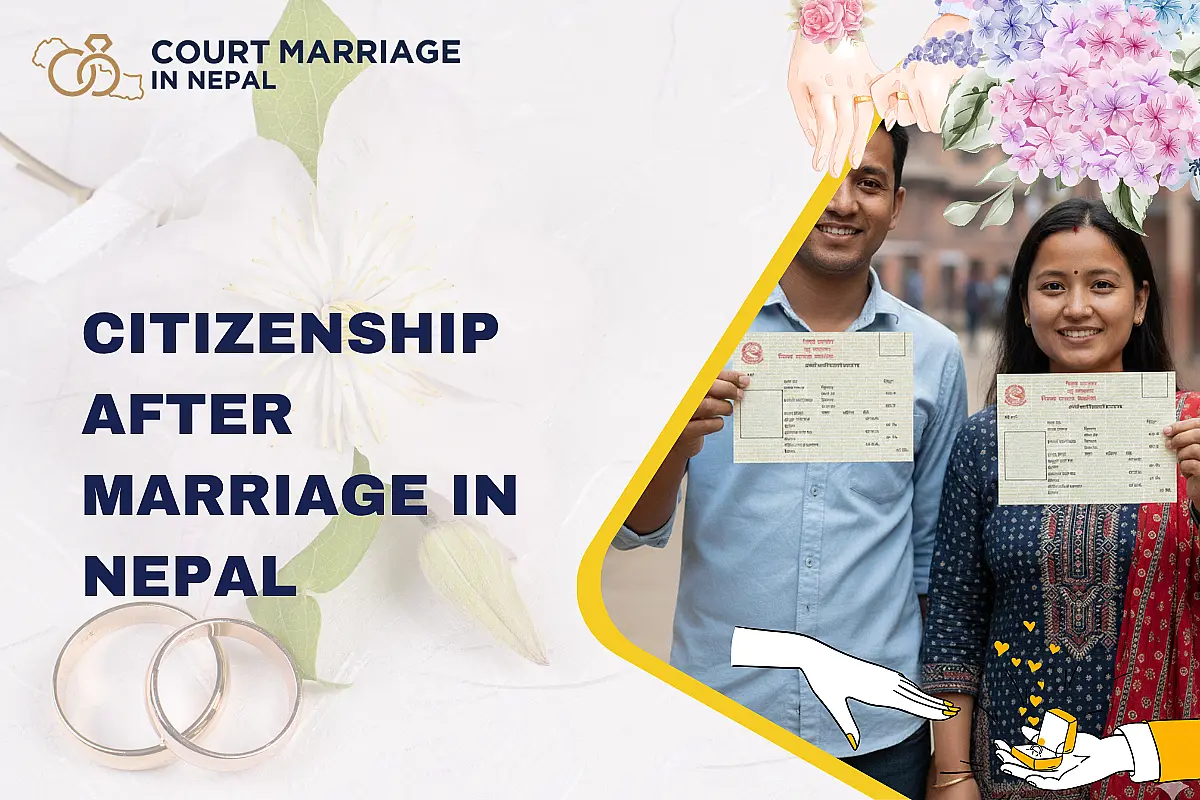
Citizenship after marriage in Nepal is governed by Article 11(6) of the Constitution of Nepal 2072 (2015). A foreign national married to a Nepali citizen may apply for naturalised citizenship after completing 7 years of continuous permanent residency in Nepal. The applicant must also renounce their foreign citizenship (Nepal does not allow dual citizenship), demonstrate basic Nepali language ability, and have a clean criminal record. The citizenship obtained is naturalised — not by descent — which carries certain constitutional restrictions.
Over 9 years helping couples navigate Nepal's marriage laws — since 2016.
Need legal guidance on citizenship after marriage? Talk to our lawyers →
What Nepal's Constitution Says About Citizenship Through Marriage
The legal basis for citizenship after marriage sits in Article 11 of the Constitution of Nepal 2072 (2015). This is the primary law — not the older Nepal Citizenship Act 2006, which has been largely superseded by the Constitution on citizenship matters.
Article 11(6): The Key Provision
Article 11(6) states that a foreign national who has been married to a Nepali citizen and has permanently resided in Nepal may acquire naturalised citizenship of Nepal. The conditions are:
- The person must be married to a Nepali citizen (the marriage must be legally registered)
- The person must have permanently resided in Nepal — the established requirement is 7 years of continuous residency
- The person must renounce their foreign citizenship
- The person must not have been convicted of a serious criminal offence
Naturalised vs Descent Citizenship: Why It Matters
The citizenship obtained through marriage is naturalised citizenship, not citizenship by descent. This is an important legal distinction under Nepal's Constitution:
| Right / Restriction | Citizenship by Descent | Naturalised Citizenship |
|---|---|---|
| Vote in elections | Yes | Yes |
| Own property | Yes | Yes — with some restrictions on land in certain areas |
| Work without permit | Yes | Yes |
| Hold public office | Yes | Restricted — cannot hold certain constitutional positions |
| Nepal passport | Yes | Yes |
| Pass citizenship to children | Yes | Yes — children qualify for citizenship by descent |
The most significant restriction is that naturalised citizens cannot hold certain high-ranking constitutional positions — including President, Vice President, Prime Minister, Chief Justice, Speaker, and similar offices. For most people, this restriction has no practical impact.
Step-by-Step: How to Apply for Citizenship After Marriage
The process from marriage to citizenship involves five distinct stages. Each stage has its own requirements, timeline, and potential complications.
Step 1: Register the Marriage Legally
The foundation of everything is a legally registered marriage. The marriage must be registered at a District Court in Nepal under the Muluki Civil Code 2074. A religious ceremony, customary marriage, or marriage registered in another country without Nepal recognition is not sufficient for the citizenship pathway.
If your marriage was registered abroad, you may need to have it recognised in Nepal through the District Court. Consult a lawyer about the recognition process, as requirements vary depending on the country where the marriage took place.
Step 2: Obtain a Spouse Visa (Non-Tourist Visa)
After marriage, the foreign spouse must obtain a Non-Tourist Visa from the Department of Immigration in Kathmandu. This is commonly called a "spouse visa" or "marriage visa," though it is technically a non-tourist visa issued on the basis of marriage to a Nepali citizen.
- First issuance: up to 6 months
- Subsequent renewals: up to 1 year at a time
- The Nepali spouse must be present at every application and renewal
- Annual renewal continues throughout the 7-year residency period
For full details on the spouse visa process, see our dedicated guide on marriage visa in Nepal.
Step 3: Complete 7 Years of Continuous Residency
This is the longest and most demanding requirement. The foreign spouse must live continuously in Nepal for 7 years. "Continuous" means maintaining Nepal as your primary residence throughout this period. Short trips abroad (for holidays, family visits, or business) are generally acceptable, but extended absences could reset or pause the residency count.
There is no official definition of how many days per year constitutes "continuous residency." In practice, maintaining your spouse visa, having a permanent address in Nepal, and being present for the majority of each year is sufficient. Keep documentation of your residency — lease agreements, utility bills, tax filings, and visa renewal records all serve as evidence.
Step 4: Renounce Foreign Citizenship
Nepal does not allow dual citizenship. Before applying for naturalised Nepali citizenship, you must formally renounce your citizenship of your home country. This typically involves:
- Applying to your home country's government for citizenship renunciation
- Obtaining a renunciation certificate or equivalent document
- Having the renunciation document authenticated for use in Nepal
This is an irreversible decision with significant consequences. Some countries — including the United States — charge substantial fees for citizenship renunciation. Others may not allow renunciation until you have acquired another citizenship, creating a timing challenge. Consult both a Nepali lawyer and a lawyer in your home country before taking this step.
Step 5: Apply at the District Administration Office
Once all conditions are met, the application for naturalised citizenship is submitted at the District Administration Office (DAO) in the district where you reside. The application is reviewed and forwarded to the Ministry of Home Affairs for final approval.
The review process involves:
- Verification of marriage registration
- Verification of 7-year continuous residency
- Criminal background check
- Verification of citizenship renunciation
- Language assessment (basic Nepali ability)
- Recommendation from the local Ward Office
Processing times vary significantly — from several months to over a year, depending on administrative workload and the complexity of the case.
Documents Required for Citizenship Application
| Document | Source | Notes |
|---|---|---|
| Marriage registration certificate | District Court, Nepal | Must be the original Nepal-registered certificate |
| Nepali spouse's citizenship certificate | Spouse's records | Original + copy |
| Foreign passport (current and expired) | Home country | Shows entry/exit records for residency verification |
| Non-Tourist Visa records (all 7 years) | Department of Immigration | Proves continuous legal residency |
| Citizenship renunciation certificate | Home country government | Must be authenticated for Nepal use |
| Ward Office recommendation letter | Local Ward Office | Confirms you reside in the ward |
| Police clearance certificate | Nepal Police | Clean criminal record in Nepal |
| Passport-size photographs | Photo studio | Recent, per specification |
| Proof of residence (lease, utility bills) | Personal records | Supports the 7-year residency claim |
| Application form | District Administration Office | Completed in Nepali |
Rights of Foreign Spouses Before Citizenship
During the 7-year waiting period, you are a foreign national with a spouse visa — not a Nepali citizen. Your rights and restrictions during this period are important to understand.
What You Can Do
- Live in Nepal — legally, on the spouse visa, with annual renewals
- Open a bank account — with your passport and visa as identification
- Start a business — subject to foreign investment regulations (Foreign Investment and Technology Transfer Act)
- Access healthcare — no restrictions on private healthcare
- Enrol children in school — no restrictions
What You Cannot Do (or Face Restrictions)
- Own land in your name — foreign nationals cannot own land in Nepal. Property must be in your Nepali spouse's name
- Work freely — you need a work permit from the Department of Labour unless you are self-employed through a registered business
- Vote — only citizens can vote
- Hold government jobs — reserved for Nepali citizens
- Travel without a visa — you still need your foreign passport and valid Nepal visa
Questions about your rights as a foreign spouse? Our lawyers can advise →
The Gender Discrimination Controversy
Nepal's citizenship-through-marriage provisions have been the subject of significant controversy since the 2015 Constitution was adopted. The core issue is a perceived difference in how the law treats foreign wives versus foreign husbands of Nepali citizens.
The Constitutional Debate
Critics argue that Article 11 — as written and as implemented — makes it harder for foreign men married to Nepali women to obtain citizenship compared to foreign women married to Nepali men. The stated rationale behind the stricter provisions was concern about cross-border marriages from India being used to acquire Nepali citizenship in large numbers, particularly in the Terai region.
Several advocacy groups and human rights organisations have challenged these provisions as discriminatory under Article 18 (right to equality) of the same Constitution. The Supreme Court of Nepal has issued directives on the matter, but a definitive resolution has not been reached as of April 2026.
Practical Impact
In practice, the 7-year residency requirement applies to all foreign spouses regardless of gender. However, the administrative processing of applications and the scrutiny applied may vary. Foreign spouses — particularly from neighbouring countries — should be prepared for a thorough review process and potential delays.
Citizenship for Children of Mixed-Nationality Couples
The citizenship of children born to a Nepali parent and a foreign parent is a separate but related legal question. The Constitution addresses this under Articles 11(3) and 11(5):
When the Father Is Nepali
A child born to a Nepali father and a foreign mother is entitled to citizenship by descent — the full form of Nepali citizenship with no restrictions. This applies whether the child is born in Nepal or abroad, provided the father's Nepali citizenship is established.
When the Mother Is Nepali
A child born to a Nepali mother and a foreign father can obtain Nepali citizenship, but the provisions have been contested. Article 11(5) requires that the foreign father's identity be ascertained for the child to receive citizenship by descent. If the father's identity is not established (or the father has not acquired Nepali citizenship), the child may receive naturalised citizenship rather than citizenship by descent.
This distinction has been widely criticised as gender-discriminatory. Multiple petitions have been filed in the Supreme Court challenging this provision. The legal position continues to evolve, and parents in mixed-nationality marriages should consult a lawyer for the most current guidance on their children's citizenship rights.
Practical Steps for Children's Citizenship
- Register the child's birth at the local Ward Office within 35 days
- Obtain the birth certificate with both parents' details
- Apply for the child's citizenship certificate at the District Administration Office when the child turns 16 (or earlier for a minor passport)
- If one parent is foreign, prepare additional documentation including the marriage certificate and the foreign parent's identity documents
Common Reasons for Citizenship Rejection
Not every application succeeds. Common reasons for rejection include:
- Incomplete residency: Gaps in the 7-year period, extended absences, or inadequate documentation of continuous presence
- Unresolved foreign citizenship: Failure to provide proof of renunciation or pending renunciation that has not been finalised
- Criminal record: Any criminal conviction in Nepal or an unresolved criminal matter in the home country
- Marriage validity issues: If the marriage registration has been challenged or there are questions about its validity
- Insufficient language ability: Cannot demonstrate basic conversational Nepali
- Missing documents: Incomplete application file — particularly common with foreign documents that were not properly authenticated
- Administrative delays: Applications can be delayed indefinitely due to policy changes or administrative backlogs
What If You Divorce Before Getting Citizenship?
If the marriage ends in divorce before the foreign spouse completes the 7-year residency requirement, the citizenship pathway is effectively closed. The basis for the application is the marriage — without a valid marriage to a Nepali citizen, there is no constitutional provision for the foreign national to continue the naturalisation process.
If the divorce occurs after the 7-year period but before the citizenship application is approved, the legal position is less clear. The applicant met the residency requirement while the marriage was valid, but the current marital status at the time of application may be relevant. This is an area where legal advice is essential.
Alternatives to Citizenship: Long-Term Residency
Not every foreign spouse wants or needs Nepali citizenship. Giving up your home country citizenship is a significant decision. The alternative is to continue living in Nepal on the spouse visa indefinitely:
- The spouse visa has no upper limit on renewals — you can renew annually for as long as the marriage exists
- You maintain your foreign citizenship and passport
- You can travel freely using your foreign passport
- The trade-off is that you cannot own land, vote, or hold government positions in Nepal
Many foreign spouses choose this option — maintaining their home citizenship while living in Nepal on the spouse visa. It provides the security of keeping your original nationality while enjoying the practical benefits of living in Nepal with your family.
Conclusion
Citizenship after marriage in Nepal is a 7-year journey with strict requirements at every step — from legal marriage registration to continuous residency to renouncing your foreign citizenship. The process is not automatic, and the legal framework continues to evolve as constitutional debates about gender equality in citizenship provisions play out. Whether you are just starting the process or nearing the 7-year mark, professional legal guidance ensures you do not make mistakes that could delay or derail your application.
Our lawyers have advised hundreds of mixed-nationality couples on the citizenship pathway. We can assess your eligibility, prepare your documentation, and guide you through the District Administration Office application process.
Contact our lawyers for a free consultation on your citizenship options →
Frequently Asked Questions
No. Marriage to a Nepali citizen does not confer automatic citizenship. It provides a legal pathway to naturalised citizenship under Article 11(6) of the Constitution, which requires 7 years of continuous permanent residency, renunciation of foreign citizenship, and a clean criminal record.
A minimum of 7 years from the date of marriage and continuous residency in Nepal. After meeting the residency requirement, the application and processing at the District Administration Office can take several additional months to over a year.
Yes. Nepal does not allow dual citizenship. You must formally renounce your foreign citizenship before your naturalisation application can be approved. This is irreversible — consult a lawyer in both Nepal and your home country before proceeding.
No. Foreign nationals cannot own land in Nepal regardless of marital status. Property must be registered in your Nepali spouse's name. Only after obtaining naturalised citizenship can you own land in your own name.
Citizenship by descent is for persons born to Nepali parents — it carries full rights. Naturalised citizenship is acquired through marriage or long-term residency — it carries the same rights except that holders cannot serve in certain high constitutional positions like President or Prime Minister.
You need a work permit from the Department of Labour to work for an employer in Nepal. Self-employment through a registered business is possible under foreign investment regulations. The spouse visa alone does not grant automatic work rights.
If you divorce before completing 7 years of residency, the citizenship pathway closes. If you divorce after 7 years but before the application is processed, the outcome is uncertain and depends on case-specific circumstances. Legal advice is essential.
This is an active constitutional debate. Critics argue that Article 11 provisions make it harder for foreign husbands of Nepali women to obtain citizenship compared to foreign wives of Nepali men. The Supreme Court has issued directives, but a definitive resolution has not been reached as of 2026.
Children of a Nepali father receive citizenship by descent regardless of the mother's nationality. Children of a Nepali mother and foreign father face additional requirements under Article 11(5), which has been challenged as discriminatory. Consult a lawyer for current rules.
Key documents include: marriage certificate, Nepali spouse's citizenship, your foreign passport, all Non-Tourist Visa records (7 years), citizenship renunciation certificate, Ward Office recommendation, police clearance, proof of residence, photographs, and the application form.
Yes. Once you receive your naturalised citizenship certificate, you can apply for a Nepali e-Passport at the Department of Passports. You will have already renounced your foreign citizenship and passport at that point.
Article 11(6) requires that the foreign spouse has permanently resided in Nepal — the established requirement is 7 years of continuous presence. You must maintain a valid spouse visa throughout this period and keep records proving your continuous residence.
Yes. The spouse visa (Non-Tourist Visa) can be renewed annually with no upper limit, allowing indefinite residence in Nepal. Many foreign spouses choose this option to avoid renouncing their home country citizenship while still living permanently in Nepal.
Yes. The naturalisation process requires demonstrating basic Nepali language ability. This is not a formal examination but a practical assessment during the application review. Basic conversational ability is sufficient — fluency is not required.
The application is submitted at the District Administration Office (DAO) in the district where you reside. The DAO reviews and forwards the application to the Ministry of Home Affairs for final approval. The Nepali spouse should accompany you during the application.
Court Marriage in Nepal Pvt. Ltd. is Nepal's first registered law firm for court marriage services. Since 2016, our Nepal Bar Council-registered advocates have helped 2,000+ couples from 50+ countries with marriage registration, document preparation, and legal consultation. Whether you are a Nepali citizen or a foreign national, contact us today for confidential legal assistance.