Table of Contents
- What Is an FIR (First Information Report)?
- When Should You File an FIR?
- Which Police Station to Go To
- What to Bring When Filing an FIR
- Step-by-Step FIR Filing Process
- FIR Filing Process Flowchart
- Online Police Complaint in Nepal
- What Happens After Filing an FIR?
- Can Police Refuse to Take Your FIR?
- FIR for Domestic Violence and Marriage-Related Crimes
- Statute of Limitations for Filing FIR
- Rights of the Complainant After Filing FIR
- Can You Withdraw an FIR in Nepal?
- False FIR: Legal Consequences
- FIR for Foreigners in Nepal
- Important Contacts for Filing FIR in Nepal
Filing a First Information Report (FIR) is the first legal step you take when a crime occurs in Nepal. Whether you are a victim of theft, assault, fraud, domestic violence, or any other criminal offence, the FIR — known as Jaaheri (जाहेरी) or Pratham Suchana Pratibedan (प्रथम सूचना प्रतिवेदन) in Nepali — triggers the official police investigation process. Without filing an FIR, Nepal Police generally cannot begin a criminal investigation into your complaint.
Despite being a fundamental right under the National Criminal Procedure Code 2074, many people in Nepal struggle with the FIR process — unclear procedures, police reluctance, jurisdictional confusion, and fear of retaliation keep thousands from reporting crimes each year. This comprehensive guide explains every aspect of filing an FIR in Nepal in 2026, from choosing the right police station to knowing your rights when police refuse to register your complaint.
An FIR (First Information Report) in Nepal is a written document prepared by police when a victim or witness reports a cognizable offence. File it at the nearest police station where the crime occurred. Bring your citizenship or ID, describe the crime in detail, and the police must register it. If police refuse, you can complain to the District Police Office, the National Human Rights Commission, or file a writ petition in the District Court. There is no fee to file an FIR in Nepal.
What Is an FIR (First Information Report)?
An FIR is the official written record of a crime reported to Nepal Police. It is the first step in the criminal justice process and sets the entire investigation in motion. Under Section 3 of the National Criminal Procedure (Code) Act, 2074 (2017), any person who has knowledge of a criminal offence can report it to the police.
| Detail | Information |
|---|---|
| Official Name | First Information Report (FIR) / Jaaheri (जाहेरी) |
| Nepali Term | प्रथम सूचना प्रतिवेदन (Pratham Suchana Pratibedan) |
| Governing Law | National Criminal Procedure (Code) Act, 2074 |
| Who Can File | Victim, witness, family member, or any person aware of the offence |
| Where to File | Nearest police station where the crime occurred |
| Filing Fee | Free — no charge to file an FIR |
| Time Limit | Varies by offence — generally within the statute of limitations under Schedule 1/2 of the Criminal Code |
| Language | FIR is recorded in Nepali |
FIR vs General Diary (GD) Entry
Not every police complaint becomes an FIR. Nepal Police distinguishes between:
- FIR (Jaaheri): Filed for cognizable offences — serious crimes where police can arrest without a warrant and must investigate immediately (e.g., murder, robbery, kidnapping, assault, fraud).
- General Diary (GD) Entry: Filed for non-cognizable offences — less serious matters where police record the complaint but may not investigate unless directed by a court (e.g., minor disputes, verbal threats, defamation).
The Criminal Code 2074 (Muluki Criminal Code) classifies offences into Schedule 1 (government as plaintiff — serious) and Schedule 2 (victim as plaintiff), which determines how the FIR proceeds.
When Should You File an FIR?
You should file an FIR whenever a cognizable criminal offence has been committed. Common situations that require an FIR include:
| Category | Examples of Offences | Criminal Code Section |
|---|---|---|
| Crimes Against Person | Murder, attempt to murder, assault, grievous hurt | Sections 177–196 |
| Theft & Robbery | Theft, house-breaking, dacoity, robbery | Sections 203–215 |
| Fraud & Cheating | Cheating, forgery, impersonation, embezzlement | Sections 216–231 |
| Sexual Offences | Rape, sexual harassment, child sexual abuse | Sections 219–226 |
| Kidnapping | Kidnapping, hostage-taking, human trafficking | Sections 165–176 |
| Domestic Violence | Physical, mental, sexual, or economic abuse by family member | DV Act 2066 |
| Cyber Crime | Online fraud, hacking, cyber bullying, identity theft | Electronic Transactions Act 2063 |
| Drug Offences | Drug trafficking, possession, manufacturing | Narcotic Drugs Control Act 2033 |
| Property Crimes | Land encroachment, criminal trespass, arson | Sections 232–245 |
When NOT to File an FIR
An FIR is not appropriate for:
- Civil disputes: Property partition, contract disagreements, debt recovery — these go through civil courts.
- Family matters handled by other laws: Divorce and child custody are filed under the Muluki Civil Code, not through an FIR.
- Non-cognizable offences: Minor verbal disputes, defamation, or nuisance complaints are typically recorded as a GD entry.
Which Police Station to Go To
The general rule is to file your FIR at the police station that has jurisdiction over the area where the crime occurred. This is called the "area police station" (ilaka prahari karyalaya).
| Situation | Where to File |
|---|---|
| Crime happened at a specific location | Nearest police station to that location |
| Crime happened while travelling | Any police station along the route, or destination station |
| Online / cyber crime | Nepal Police Cyber Bureau, Bhotahity, Kathmandu OR local police station |
| Domestic violence | Nearest police station or Women & Children Service Centre |
| Crime occurred in another district | Your local police station can forward it — but faster if you go to the jurisdictional station |
| Cross-border crime (fraud from abroad) | Metropolitan Police Crime Division or Central Investigation Bureau (CIB) |
Key contacts for specialised complaints:
- Nepal Police Headquarters: 100 (emergency), 01-4411210
- Cyber Bureau: 01-4005268 / cybercrime@nepalpolice.gov.np
- Women & Children Service Directorate: 1145 (helpline)
- CIB (Central Investigation Bureau): 01-4412509
What to Bring When Filing an FIR
While there is no mandatory document requirement to file an FIR (police must register your complaint even without documents), bringing the following strengthens your case:
| Document | Purpose | Required? |
|---|---|---|
| Citizenship Certificate or National ID Card | Confirms your identity | Strongly recommended |
| Passport (for foreigners) | Identity verification for non-Nepali victims | Required for foreigners |
| Written complaint (in Nepali) | Pre-written detailed account speeds up the process | Optional but helpful |
| Evidence — photos, CCTV footage, screenshots | Supports your complaint | Optional |
| Medical report (for assault/injury cases) | Documents physical harm | Strongly recommended |
| Witness details — name, phone number, address | Police will record witness statements | Optional but very helpful |
| Financial documents (for fraud cases) | Bank statements, cheques, contracts, receipts | Strongly recommended |
If you are a foreigner in Nepal and become a crime victim, you can file an FIR at any police station. Bring your passport and contact your embassy for consular assistance. If you are in Nepal for court marriage in Nepal, ensure you also get a copy of the FIR for your embassy records if needed.
Step-by-Step FIR Filing Process
Here is the complete process to file an FIR at a Nepal Police station:
Step 1: Visit the Police Station
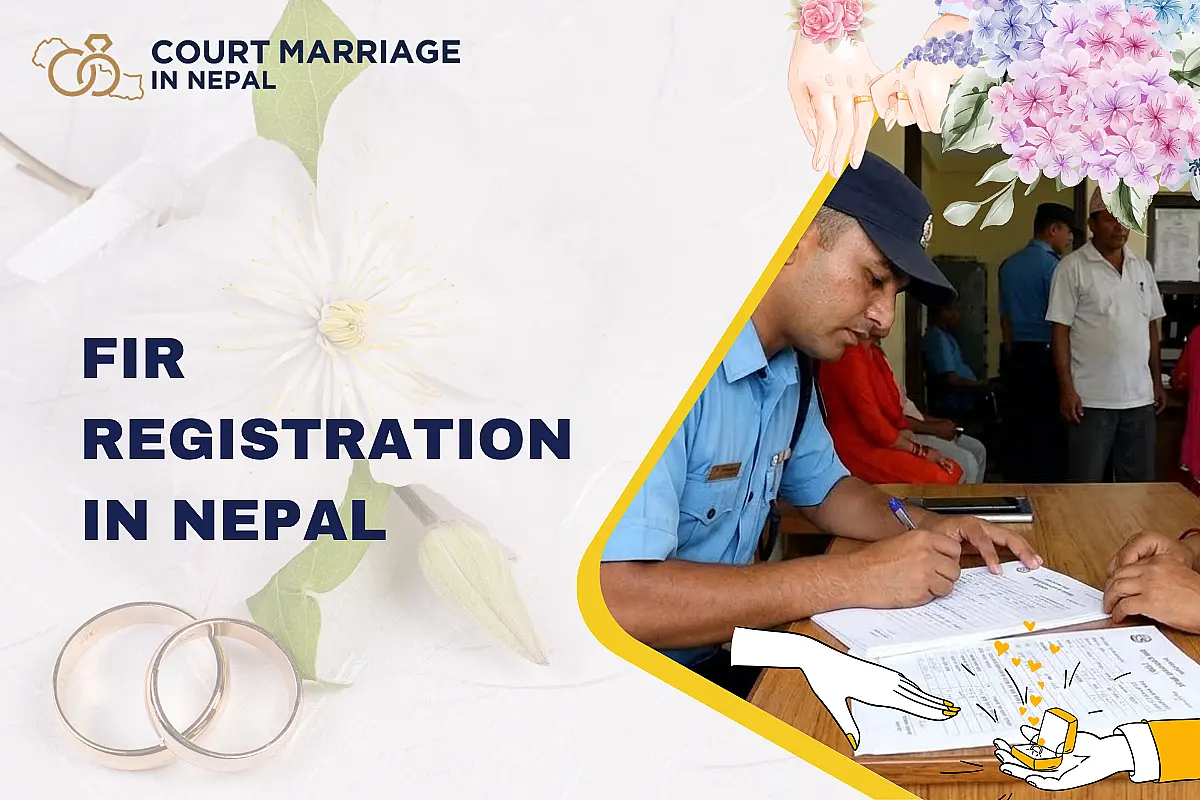
Go to the nearest police station where the crime occurred. Police stations in Nepal are generally open 24 hours for FIR registration, though administrative staff may be available only during office hours (10 AM to 5 PM, Sunday to Friday).
Step 2: Meet the Duty Officer
At the station, ask for the Duty Officer or the officer in charge. Explain that you want to file an FIR. You will be directed to the officer responsible for recording complaints.
Step 3: Provide Your Statement
Give a detailed oral or written statement about the crime. Include:
- What happened (nature of the offence)
- When it happened (date and time)
- Where it happened (exact location)
- Who committed the crime (if known — name, description)
- Names and contact details of any witnesses
- Any evidence you have
Step 4: FIR Is Written and Recorded
The duty officer writes the FIR in the official register. Under the National Criminal Procedure Code 2074, the FIR must contain:
- Name, address, and contact details of the complainant
- Description of the offence and when/where it occurred
- Name of the accused (if known)
- Details of witnesses
- List of any evidence or documents submitted
Step 5: Read and Sign the FIR
The officer will read the FIR back to you. Read it carefully before signing. Ensure all facts are recorded accurately. Once you sign, the FIR becomes an official legal document. If you are illiterate, you can use a thumb impression, and the officer will read the FIR aloud in the presence of a witness.
Step 6: Get a Copy of the FIR
Always request a copy of the FIR. Under Section 3(5) of the National Criminal Procedure Code 2074, you are legally entitled to a free copy. This copy is your proof that you have filed the complaint, and you will need it for:
- Insurance claims
- Court proceedings
- Follow-up with police
- Embassy documentation (for foreigners)
- Applying for a police clearance certificate (the FIR will appear on record)
Step 7: Investigation Begins
Once the FIR is registered, the police are legally obligated to investigate the crime. For cognizable offences (Schedule 1 crimes), investigation begins immediately. The investigating officer may visit the crime scene, collect evidence, record statements, and arrest the suspect if required.
Need legal help filing an FIR or following up on a police complaint? Our experienced criminal lawyers can guide you through the process, draft your complaint, and ensure police take proper action. Contact us for a free consultation →
FIR Filing Process Flowchart
| Step | Action | Who Does It | Timeline |
|---|---|---|---|
| 1 | Visit police station and report crime | Victim / Complainant | Immediately after crime |
| 2 | Police records the FIR in register | Duty Officer | Within 1 hour |
| 3 | Complainant signs the FIR | Victim / Complainant | Same visit |
| 4 | Free copy of FIR provided | Duty Officer | Same visit |
| 5 | Crime scene investigation | Investigating Officer | Within 24 hours |
| 6 | Witness statements recorded | Investigating Officer | Within 3–7 days |
| 7 | Suspect arrested (if identified) | Police | As per investigation |
| 8 | Charge sheet filed with prosecutor | Police / Government Attorney | Within 25 days (extendable) |
Online Police Complaint in Nepal
Nepal Police has introduced an online complaint system to make it easier for people to report crimes without physically visiting a police station. While this does not fully replace an in-person FIR for serious crimes, it is useful for initial reporting.
How to File an Online Complaint
- Visit the Nepal Police website: nepalpolice.gov.np
- Navigate to the "Online Complaint" or "Complaint Box" section
- Fill in your name, contact details, and a description of the complaint
- Upload any supporting evidence (photos, screenshots, documents)
- Submit the complaint — you will receive a reference number
Online Complaint vs In-Person FIR
| Feature | Online Complaint | In-Person FIR |
|---|---|---|
| Legal Status | Preliminary complaint — police may call you in | Full legal document, triggers investigation |
| Suitable For | Cyber crime, minor offences, initial reporting | All cognizable offences |
| Evidence Submission | Digital uploads only | Physical and digital evidence |
| Follow-Up | Police may ask you to visit the station | Investigation begins immediately |
| Copy Provided | Reference number only | Signed FIR copy |
For cyber crimes, you can also file complaints directly with the Nepal Police Cyber Bureau at Bhotahity, Kathmandu, or email them at cybercrime@nepalpolice.gov.np.
What Happens After Filing an FIR?
Once an FIR is registered, the following legal process begins:
Investigation Phase
The police assign an Investigating Officer (IO) to the case. Under the National Criminal Procedure Code 2074, the IO must:
- Visit and inspect the crime scene
- Collect physical evidence and preserve it
- Record statements of the victim, witnesses, and accused
- Arrest the accused if there is reasonable suspicion (for cognizable offences)
- Complete the investigation and file a report with the Government Attorney (Sarkari Wakil)
Time Limits for Investigation
| Situation | Time Limit | Legal Basis |
|---|---|---|
| Initial investigation report | Within 25 days of arrest | Section 18, Criminal Procedure Code 2074 |
| Extension of investigation (court order) | Up to 90 days total | Section 18(3) |
| Charge sheet (prosecution decision) | After investigation completion | Section 29 |
| Remand period (suspect in custody) | Maximum 25 days initially, extendable | Section 14 |
After Investigation: Prosecution or Closure
The police forward the investigation file to the Government Attorney (District Attorney's Office). The attorney then decides whether to:
- File a charge sheet (Abhiyog Patra) in court — prosecution begins
- Request further investigation — if evidence is insufficient
- Close the case — if no evidence supports the complaint (the complainant can challenge this in court)
If prosecution begins, the case moves to the District Court for trial. The victim/complainant becomes a witness. Learn more about the complete criminal procedure in our guide to the Criminal Code 2074.
Can Police Refuse to Take Your FIR?
No. Under Section 3 of the National Criminal Procedure Code 2074, police are legally obligated to register an FIR when a cognizable offence is reported. Refusal to register an FIR is a violation of your legal rights.
What to Do If Police Refuse
Unfortunately, FIR refusal is a real problem in Nepal. If the police refuse to register your FIR, you have several legal remedies:
| Remedy | How to Use It | Effectiveness |
|---|---|---|
| 1. Complain to Senior Officer | Ask to speak to the Station In-charge (Prahari Niriyak) or go to the District Police Office (DPO) | Often resolves the issue immediately |
| 2. Written Complaint to DPO/SSP | Submit a written complaint to the Senior Superintendent of Police (SSP) of the district | Creates an official record of refusal |
| 3. Complaint to NHRC | File a complaint with the National Human Rights Commission | Triggers external investigation |
| 4. District Court Petition | File a writ petition or application in the District Court directing police to register the FIR | Legally binding — strongest remedy |
| 5. Send FIR by Registered Post | Mail your complaint to the police station via registered post — creates undeniable proof of receipt | Useful as evidence if case escalates |
| 6. Contact a Lawyer | A lawyer can accompany you to the police station and ensure your rights are upheld | Highly effective — police take lawyers seriously |
Common Reasons Police May Hesitate
- The offence is non-cognizable (they will record a GD entry instead)
- Jurisdictional issues — the crime occurred in another area
- Lack of awareness or training among officers
- Pressure from influential persons (corruption)
- Attempting to settle the matter informally (mediation)
Important: Even if police suggest mediation or informal settlement, you have the right to insist on filing an FIR. For serious crimes, never accept informal resolution.
Police refusing to register your FIR? Our criminal lawyers can accompany you to the police station and ensure your complaint is properly registered. We have successfully helped hundreds of clients navigate police reluctance. Get legal help now →
FIR for Domestic Violence and Marriage-Related Crimes
Domestic violence is one of the most common reasons people file FIRs in Nepal. The Domestic Violence (Offence and Punishment) Act 2066 (2009) provides special protections and streamlined procedures for victims.
Special Provisions for Domestic Violence FIRs
- Any police station: You can file a DV complaint at any police station, not just the jurisdictional one
- Women & Children Service Centre: Every district has a specialised centre within the police for handling DV cases
- Confidentiality: Police must maintain the privacy of the victim
- Immediate protection: Police can issue immediate protection orders while the case is being processed
- No withdrawal pressure: Police should not pressure victims to withdraw complaints or settle with the abuser
Marriage-Related Offences
Several marriage-related crimes can be reported through an FIR:
| Offence | Legal Provision | Punishment |
|---|---|---|
| Bigamy / Polygamy | Section 175, Criminal Code 2074 | Up to 5 years imprisonment |
| Child marriage | Section 173, Criminal Code 2074 | Up to 3 years imprisonment + NPR 30,000 fine |
| Forced marriage | Section 174, Criminal Code 2074 | Up to 3 years imprisonment + NPR 30,000 fine |
| Dowry-related violence | Section 176, Criminal Code 2074 | Up to 3 years imprisonment + NPR 30,000 fine |
| Domestic violence | DV Act 2066, Section 4 | Up to 6 months imprisonment or fine up to NPR 25,000 |
| Marital rape | Section 219(3), Criminal Code 2074 | Up to 5 years imprisonment |
If you are experiencing any of these issues within a marriage — whether a court marriage in Nepal or traditional marriage — you have the legal right to file an FIR and seek protection.
Statute of Limitations for Filing FIR
Nepal's Criminal Code 2074 prescribes time limits within which an FIR must be filed. If you file after the limitation period, police may still register it but prosecution becomes difficult.
| Offence Category | Limitation Period | Notes |
|---|---|---|
| Murder | No limitation | Can be filed at any time |
| Rape / Sexual offences | 1 year from the date of offence | 180 days for sexual harassment |
| Fraud / Cheating | 3 months to 1 year depending on severity | Check specific section in Criminal Code |
| Theft / Robbery | 3 months | From the date victim becomes aware |
| Domestic violence | 90 days from the date of violence | Under DV Act 2066 |
| Drug offences | 1 year | Narcotic Drugs Control Act 2033 |
Important: These are general guidelines. The exact limitation period depends on the specific section of the Criminal Code applicable to the offence. Consult a lawyer to determine the exact deadline for your case.
Rights of the Complainant After Filing FIR
After filing an FIR, you have several legal rights under Nepali law:
- Right to a free copy of the FIR — Section 3(5), Criminal Procedure Code 2074
- Right to information about investigation progress — police must update you on request
- Right to legal representation — you can hire a lawyer at any stage
- Right to free legal aid — if you cannot afford a lawyer, the government provides free legal aid through the District Legal Aid Committee
- Right to victim protection — especially in domestic violence, trafficking, and sexual offence cases
- Right to compensation — courts can order the offender to pay compensation to the victim
- Right to appeal — if the case is closed without prosecution, you can challenge it in court
If you have questions about your employment rights or need a police clearance certificate after being involved in a criminal case, our lawyers can advise you on how the FIR impacts these processes.
Can You Withdraw an FIR in Nepal?
Withdrawal depends on the type of offence:
| Offence Type | Can FIR Be Withdrawn? | Process |
|---|---|---|
| Schedule 1 (Government plaintiff) | No — complainant cannot withdraw | The government is the plaintiff; the case continues regardless of complainant's wishes |
| Schedule 2 (Victim plaintiff) | Yes — with conditions | Victim must apply to the court. Court decides based on circumstances. Mediation/compromise may be accepted |
For Schedule 1 offences (murder, rape, kidnapping, drug trafficking, etc.), once an FIR is filed, the state takes over as the plaintiff. The complainant cannot withdraw the case. For Schedule 2 offences, withdrawal or compromise is possible through the court with the consent of both parties.
False FIR: Legal Consequences
Filing a false FIR is a criminal offence in Nepal. Under Section 234 of the Criminal Code 2074, providing false information to police with the intent to frame someone or mislead an investigation is punishable by:
- Imprisonment: Up to 1 year
- Fine: Up to NPR 10,000
- Compensation: The falsely accused person can demand compensation
This provision exists to prevent misuse of the FIR system for personal vendettas, property disputes, or harassment. Before filing an FIR, ensure your complaint is genuine and supported by facts.
FIR for Foreigners in Nepal
Foreign nationals who are victims of crime in Nepal have the same right to file an FIR as Nepali citizens. Whether you are a tourist, a foreign worker, or in Nepal for visa purposes, you can report a crime at any police station.
Tips for Foreigners Filing FIR
- Carry your passport and a copy of your Nepal visa
- If you do not speak Nepali, request an interpreter — or bring a Nepali-speaking friend
- Contact your embassy or consulate immediately after filing
- Request a certified English translation of the FIR from the police station
- For insurance claims (theft, medical), the FIR copy is essential documentation
- If the crime is related to a workplace dispute or involves an employer, also contact the Department of Labour
Important Contacts for Filing FIR in Nepal
| Authority | Contact | Purpose |
|---|---|---|
| Nepal Police Emergency | 100 | Emergency crimes, accidents |
| Women & Children Helpline | 1145 | Domestic violence, child abuse |
| Cyber Bureau | 01-4005268 | Cyber crimes, online fraud |
| CIB (Central Investigation Bureau) | 01-4412509 | Serious crimes, organised crime |
| NHRC (Human Rights Commission) | 01-5010015 | Police refusal, human rights violations |
| District Legal Aid Committee | Available at each District Court | Free legal aid for victims |
| Nepal Bar Association | 01-4216857 | Finding a lawyer |
Need a criminal lawyer to help file your FIR or follow up on a case? Our legal team has extensive experience with FIR registration, police complaints, and criminal proceedings across Nepal. Whether it is a domestic violence case, fraud, theft, or any other criminal offence, we can help protect your rights. Schedule a free consultation today →
Frequently Asked Questions
An FIR (First Information Report) is the official written record of a crime reported to Nepal Police. Known as Jaaheri (जाहेरी) in Nepali, it is the first step in the criminal justice process. Police prepare the FIR when a victim or witness reports a cognizable offence, and it triggers the formal investigation.
No, filing an FIR in Nepal is completely free. There is no charge to register a police complaint. Under the National Criminal Procedure Code 2074, police must accept and record your complaint without any payment. If anyone demands money, report it to the District Police Office.
File your FIR at the nearest police station where the crime occurred. This is the jurisdictional police station. For domestic violence, you can file at any police station. For cyber crimes, file at the Nepal Police Cyber Bureau in Bhotahity, Kathmandu, or your local station.
While not strictly mandatory, bring your citizenship certificate or National ID, a written description of the crime, any evidence (photos, screenshots, CCTV footage), medical reports for assault cases, and witness contact details. Foreigners should bring their passport and visa copy.
No, police are legally obligated to register your FIR for cognizable offences under Section 3 of the National Criminal Procedure Code 2074. If they refuse, complain to the District Police Office, the National Human Rights Commission, or file a petition in the District Court.
Filing an FIR typically takes 30 minutes to 1 hour at the police station. The process involves giving your statement, the officer recording it, and you signing the document. You should receive a free copy of the FIR during the same visit.
Nepal Police offers an online complaint system through nepalpolice.gov.np. However, online complaints serve as preliminary reports. For serious crimes, you will still need to visit the police station in person for the formal FIR to be recorded and signed.
After filing, police assign an Investigating Officer who visits the crime scene, collects evidence, records witness statements, and may arrest the suspect. The investigation report is forwarded to the Government Attorney, who decides whether to prosecute the case in court.
Yes, foreign nationals have the same right to file an FIR as Nepali citizens. Carry your passport and visa copy. You can request an interpreter if you do not speak Nepali. Contact your embassy for additional consular assistance after filing the complaint.
For Schedule 1 offences (murder, rape, kidnapping), the FIR cannot be withdrawn as the state becomes the plaintiff. For Schedule 2 offences (victim as plaintiff), you can apply to the court for withdrawal or compromise with the accused party.
Time limits vary by offence. Murder has no limitation. Rape must be reported within 1 year, theft within 3 months, and domestic violence within 90 days. File as soon as possible after the crime for the strongest case. Consult a lawyer for the exact deadline.
Filing a false FIR is punishable under Section 234 of the Criminal Code 2074 with up to 1 year imprisonment and a fine of up to NPR 10,000. The falsely accused person can also demand compensation. Always ensure your complaint is genuine and factual.
An FIR is for cognizable offences (serious crimes) where police must investigate immediately. A General Diary (GD) entry is for non-cognizable offences (minor matters) where police record the complaint but may not investigate unless directed by a court order.
Yes, domestic violence is a criminal offence under the Domestic Violence Act 2066. You can file an FIR at any police station or the Women and Children Service Centre. The police must maintain confidentiality and can issue immediate protection orders for your safety.
No, a lawyer is not required to file an FIR. You can file it yourself at any police station. However, having a lawyer is highly recommended for serious cases, especially if police are reluctant to register your complaint or if you need help drafting a detailed statement.
Court Marriage in Nepal Pvt. Ltd. is Nepal's first registered law firm for court marriage services. Since 2016, our Nepal Bar Council-registered advocates have helped 2,000+ couples from 50+ countries with marriage registration, document preparation, and legal consultation. Whether you are a Nepali citizen or a foreign national, contact us today for confidential legal assistance.