Table of Contents
- What Is Gratuity Under Nepal's Labour Act 2074?
- Who Is Eligible for Gratuity in Nepal?
- Gratuity Calculation Formula in Nepal
- Step-by-Step Gratuity Calculation Example
- Difference Between Gratuity and Provident Fund
- Tax Treatment of Gratuity in Nepal
- When Must the Employer Pay Gratuity?
- How to Claim Unpaid Gratuity in Nepal
- Gratuity for Part-Time and Contract Workers
- Gratuity When Changing Jobs
- Common Employer Violations Regarding Gratuity
- Gratuity Calculation Quick Reference
Every employee in Nepal who completes continuous service is entitled to gratuity (Upadan) — a lump-sum retirement benefit calculated as a percentage of basic salary for each year worked. Under the Labour Act 2074 (2017) and the Social Security Act 2074, gratuity is no longer a discretionary bonus; it is a legally enforceable right. Yet thousands of workers across Nepal leave their jobs without claiming what they are owed, simply because they do not understand how gratuity is calculated or how to claim it.
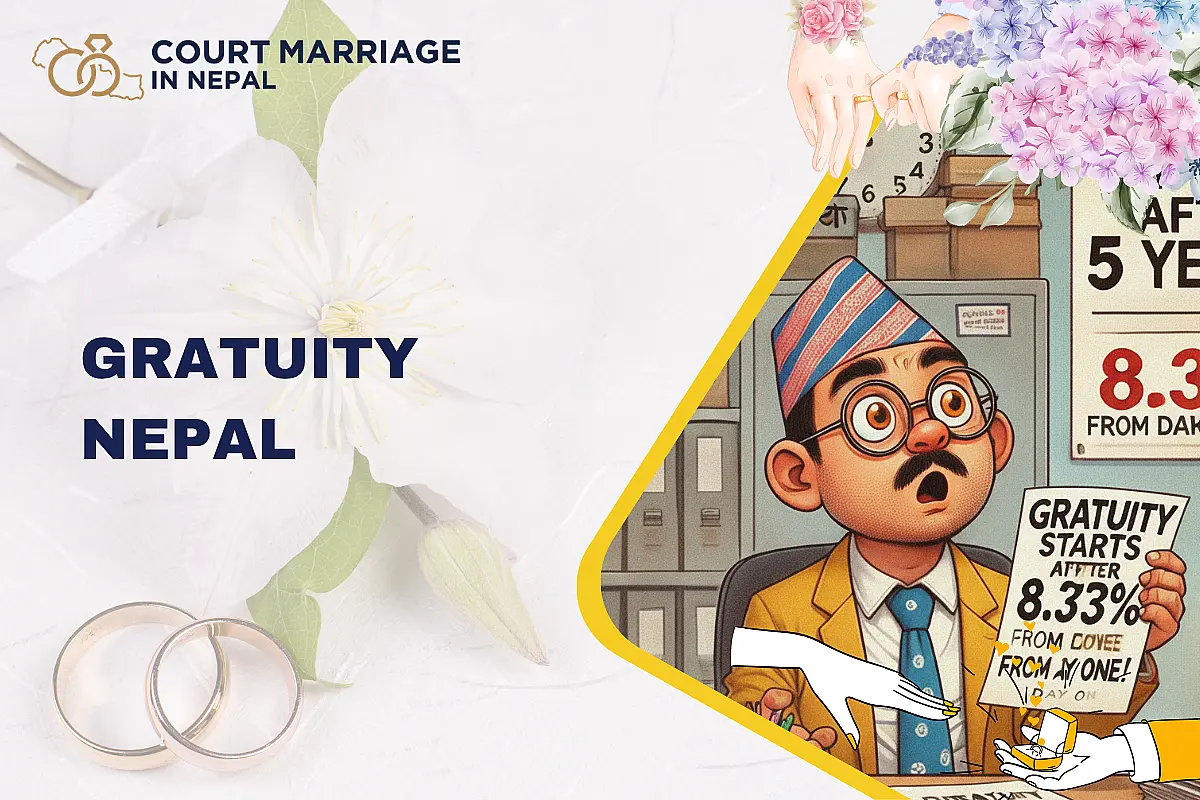
As of 2026, employers enrolled in Nepal's Social Security Fund (SSF) deposit gratuity at 8.33% of basic salary every month into the employee's SSF account. For employers not yet enrolled in SSF, the old lump-sum gratuity system under Section 52 of the Labour Act still applies. This guide covers both systems — the formula, eligibility, step-by-step calculation, tax treatment, and what to do when your employer refuses to pay.
Gratuity in Nepal is calculated at 8.33% of basic salary per month under the SSF system (employer's contribution). For non-SSF employers, the Labour Act 2074 Section 52 provides a lump-sum formula based on last drawn salary multiplied by years of service. Gratuity is tax-exempt up to NPR 500,000 under the Income Tax Act 2058. Employees must complete at least 3 years of continuous service to qualify for the lump-sum gratuity. To claim unpaid gratuity, file a complaint at the District Labour Office.
For the full legal framework governing employment in Nepal, read our comprehensive guide on labour law in Nepal.
What Is Gratuity Under Nepal's Labour Act 2074?
Gratuity (Upadan) is a statutory retirement benefit payable by an employer to an employee upon separation from service. It recognises long-term loyalty and provides financial security after employment ends. In Nepal, gratuity is governed by two overlapping legal frameworks:
- Section 52 of the Labour Act 2074 — provides the traditional lump-sum gratuity formula for employees not enrolled in SSF
- Social Security Act 2074 — integrates gratuity into the SSF contribution system at 8.33% of basic salary (part of the employer's 20% contribution)
Unlike a bonus or incentive, gratuity is mandatory. An employer cannot waive it through contract terms, and an employee cannot be asked to forfeit it except in cases of serious misconduct involving criminal conviction.
If you are also contributing to the Social Security Fund (SSF), your gratuity is already being accumulated in your SSF account through your employer's monthly contributions.
Who Is Eligible for Gratuity in Nepal?
Not every worker automatically qualifies for gratuity. The Labour Act 2074 sets specific eligibility requirements:
| Requirement | Details |
|---|---|
| Minimum service | 3 years of continuous service with the same employer (for lump-sum gratuity under Section 52) |
| Employment type | Regular (permanent) employees. Contract and temporary workers may qualify if the contract exceeds 3 years |
| SSF-enrolled employees | No minimum service requirement — gratuity accrues from month one through the 8.33% employer contribution |
| Reason for separation | Resignation, retirement, redundancy, employer termination, or death of the employee |
| Disqualification | Only if terminated for criminal misconduct that results in a court conviction |
Key point: If your employer is enrolled in SSF and has been depositing the 8.33% gratuity contribution, you do not need to complete 3 years to access your gratuity — it accumulates in your SSF account from day one.
Gratuity Calculation Formula in Nepal
The formula depends on whether your employer participates in the SSF system or not.
System 1: SSF-Enrolled Employers (Current Standard)
Under the Social Security Act 2074, gratuity is part of the employer's 20% SSF contribution:
| Component | Rate | Paid By |
|---|---|---|
| Pension | 10% | Employer |
| Gratuity | 8.33% | Employer |
| Medical & Maternity | 1.67% | Employer |
| Total Employer Contribution | 20% | Employer |
Formula: Monthly Gratuity Deposit = Basic Salary x 8.33%
Total Gratuity at Separation = Sum of all monthly 8.33% deposits + any interest accrued in the SSF account.
System 2: Non-SSF Employers (Traditional Lump-Sum)
For employers not yet enrolled in SSF (typically smaller enterprises or those in transition), Section 52 of the Labour Act 2074 provides the traditional formula:
Gratuity = (Last Drawn Monthly Basic Salary / 30) x Number of Days Worked
The rate per completed year of service is:
| Years of Service | Gratuity Rate |
|---|---|
| 3 to 7 years | One month's basic salary per year |
| 7 to 15 years | One and a half month's basic salary per year (for years beyond 7) |
| Above 15 years | Two months' basic salary per year (for years beyond 15) |
This tiered system means employees with longer service receive proportionally higher gratuity per year — a deliberate incentive for workforce retention.
Need help calculating your gratuity? Speak with our employment lawyers today.
Step-by-Step Gratuity Calculation Example
Let us work through two practical examples — one for each system.
Example 1: SSF-Enrolled Employee
Employee details: Basic salary NPR 30,000/month, worked for 5 years (60 months)
| Component | Calculation | Amount (NPR) |
|---|---|---|
| Monthly gratuity deposit | 30,000 x 8.33% | 2,499 |
| Total over 60 months | 2,499 x 60 | 1,49,940 |
| SSF interest (estimated) | Varies annually | ~15,000 |
| Total Gratuity | ~1,64,940 |
Example 2: Non-SSF Employer (Section 52)
Employee details: Last drawn basic salary NPR 30,000/month, worked for 10 years
| Years | Rate | Calculation | Amount (NPR) |
|---|---|---|---|
| First 7 years | 1 month per year | 30,000 x 7 | 2,10,000 |
| Next 3 years (8-10) | 1.5 months per year | 30,000 x 1.5 x 3 | 1,35,000 |
| Total Gratuity | 3,45,000 |
Important: In the non-SSF system, gratuity is calculated on the last drawn basic salary, not on the average salary over the employment period. This means a salary increase just before separation directly increases your gratuity.
Difference Between Gratuity and Provident Fund
Many employees confuse gratuity with provident fund. They are separate entitlements under Nepal's labour law:
| Feature | Gratuity (Upadan) | Provident Fund |
|---|---|---|
| Legal basis | Labour Act 2074 Section 52 / SSF Act | SSF Act / Employees Provident Fund Act |
| Who pays? | Employer only (8.33% under SSF) | Both employer and employee contribute |
| Purpose | Retirement reward for long service | Mandatory savings for retirement |
| Minimum service | 3 years (non-SSF) / None (SSF) | No minimum for SSF contributions |
| Withdrawal | Upon separation from employer | Upon retirement or specific conditions |
| Under SSF | Part of employer's 20% contribution | Part of the 10%+10% pension component |
Both gratuity and provident fund are now integrated into the Social Security Fund for enrolled employers. Employees receive both benefits — they are not alternatives.
Tax Treatment of Gratuity in Nepal
Gratuity enjoys favourable tax treatment under Nepal's Income Tax Act 2058 (2002):
- Tax-exempt up to NPR 500,000 — gratuity received up to this threshold is not subject to income tax
- Amount exceeding NPR 500,000 — taxed as regular income in the year of receipt, added to your taxable salary for that fiscal year
- SSF withdrawals — the gratuity component within SSF is subject to SSF's own withdrawal and taxation rules, which may differ slightly from the lump-sum treatment
For example, if you receive NPR 8,00,000 in gratuity:
| Component | Amount (NPR) | Tax Status |
|---|---|---|
| First 5,00,000 | 5,00,000 | Tax-exempt |
| Remaining amount | 3,00,000 | Taxed as income |
Make sure to file your annual tax return correctly if your gratuity exceeds the exemption limit. For complete tax details, see our guide on income tax in Nepal.
When Must the Employer Pay Gratuity?
The Labour Act 2074 is clear on payment timelines:
- Upon resignation or retirement: Within 7 days of the last working day
- Upon termination by employer: Within 7 days of the termination date
- Upon death of employee: Paid to the legal heir or nominee within 30 days
- SSF-enrolled employees: The employee can withdraw the gratuity balance from their SSF account following the fund's withdrawal procedures
If the employer delays payment beyond these deadlines, the employee is entitled to interest on the unpaid amount at the prevailing bank rate. Deliberate non-payment constitutes a labour law violation that can be reported to the Labour Office.
How to Claim Unpaid Gratuity in Nepal
If your employer refuses to pay gratuity or disputes the amount, follow this process:
Step 1: Written Demand
Send a formal written demand (notice letter) to your employer through registered post or email. Clearly state the amount owed and the legal basis (Section 52 of the Labour Act 2074). Allow 15 days for response.
Step 2: Complaint at District Labour Office
If the employer does not respond or refuses payment, file a complaint at the District Labour Office (Shram Karyalaya) of the district where you worked. The Labour Officer will summon the employer and attempt conciliation.
Step 3: Labour Court
If conciliation fails, the Labour Office refers the dispute to the Labour Court (Shram Adalat). You can file a case seeking:
- Full gratuity payment with interest
- Penalty on the employer for delayed payment
- Any other outstanding dues (severance, leave encashment, overtime)
Labour Court cases for gratuity typically attract filing fees of NPR 500 to NPR 1,000 depending on the claim amount. The court can order the employer to pay the full gratuity plus compensation.
Employer refusing your gratuity? Our employment lawyers can help you file a claim.
Gratuity for Part-Time and Contract Workers
The Labour Act 2074 distinguishes between different categories of workers regarding gratuity eligibility:
| Worker Type | Gratuity Entitlement |
|---|---|
| Regular (permanent) | Full gratuity under both SSF and Section 52 systems |
| Contract workers (over 3 years) | Eligible if total continuous contract period exceeds 3 years |
| Contract workers (under 3 years) | Not eligible for lump-sum gratuity, but SSF contributions (if enrolled) accumulate |
| Part-time workers | Pro-rata gratuity if meeting minimum service requirements |
| Daily-wage workers | Generally not eligible unless employment is continuous and exceeds 3 years |
| Foreign workers | Eligible if holding a valid work permit and meeting service requirements |
If you are a domestic worker, note that domestic workers were historically excluded from many labour protections. However, recent legal developments are expanding coverage — see our guide on the broader labour law framework for the latest updates.
Gratuity When Changing Jobs
When you switch employers in Nepal, your gratuity entitlement depends on your SSF status:
- SSF-enrolled: Your SSF account is portable. The gratuity balance remains in your account and your new employer continues contributing 8.33%. You do not lose accumulated gratuity when changing jobs.
- Non-SSF: You must claim lump-sum gratuity from your previous employer before joining the new one. The gratuity counter resets to zero at the new employer.
This portability is one of the major advantages of the SSF system — employees no longer lose retirement benefits when changing employers.
Common Employer Violations Regarding Gratuity
Based on Labour Court records and our practice experience, these are the most frequent gratuity violations in Nepal:
- Non-deposit of 8.33% to SSF — employer deducts SSF from the employee's salary but does not deposit the employer's share
- Forcing resignation before 3 years — some employers terminate workers just before the 3-year mark to avoid lump-sum gratuity liability
- Paying gratuity on gross salary minus allowances — gratuity should be calculated on basic salary, but some employers use a lower base
- Delaying payment beyond 7 days — common in companies facing cash flow problems
- Including gratuity in CTC and not paying separately — gratuity is a statutory obligation above and beyond the agreed salary
If you encounter any of these situations, document everything and consult a labour lawyer. For disputes that cannot be resolved internally, the Labour Court provides an effective remedy.
Gratuity Calculation Quick Reference
| Parameter | SSF System | Non-SSF (Section 52) |
|---|---|---|
| Rate | 8.33% of basic salary/month | 1 to 2 months' salary/year (tiered) |
| Minimum service | None (accrues from month 1) | 3 years continuous |
| Calculation base | Monthly basic salary | Last drawn basic salary |
| Payment | Monthly deposit to SSF account | Lump sum upon separation |
| Portability | Yes (SSF account moves with you) | No (claimed per employer) |
| Tax exemption | SSF withdrawal rules apply | First NPR 500,000 tax-free |
| Legal reference | Social Security Act 2074 | Labour Act 2074 Section 52 |
If you are planning to register a new company and want to understand your obligations toward employees, including gratuity, start with our guide on company registration in Nepal.
Frequently Asked Questions
Gratuity (Upadan) is a statutory retirement benefit that employers in Nepal must pay to employees upon separation from service. Under the Labour Act 2074, it rewards long-term service and is calculated based on basic salary and years worked. It is mandatory and cannot be waived by contract.
Under the SSF system, employers deposit 8.33% of the employee's basic salary every month into the SSF account as gratuity. For example, if your basic salary is NPR 30,000, your employer deposits NPR 2,499 monthly. The total gratuity equals all monthly deposits plus any interest accrued.
For the traditional lump-sum gratuity under Section 52 of the Labour Act 2074, employees must complete 3 years of continuous service. However, for SSF-enrolled employees, gratuity accrues from the first month of employment with no minimum service requirement.
Non-SSF employers calculate gratuity on a tiered basis: 1 month's basic salary per year for years 3–7, 1.5 months per year for years 7–15, and 2 months per year beyond 15 years. The calculation uses the last drawn basic salary.
Gratuity is tax-exempt up to NPR 500,000 under the Income Tax Act 2058. Any amount exceeding this threshold is taxed as regular income in the year of receipt. SSF withdrawals may follow slightly different taxation rules under the Social Security Act.
Gratuity is paid entirely by the employer (8.33% under SSF), while provident fund involves contributions from both employer and employee. Gratuity rewards long service, while provident fund is mandatory retirement savings. Under SSF, both are separate components of the total 31% contribution.
The employer must pay gratuity within 7 days of the employee's last working day — whether the separation is due to resignation, retirement, or termination. In case of the employee's death, payment must be made to the nominee within 30 days.
First, send a written demand letter to your employer allowing 15 days for response. If they refuse, file a complaint at the District Labour Office for conciliation. If conciliation fails, the matter is referred to the Labour Court where you can claim full gratuity plus interest.
Contract workers are eligible for lump-sum gratuity if their total continuous contract period exceeds 3 years. If enrolled in SSF, the 8.33% gratuity contribution accrues from the start regardless of contract duration. Short-term contracts under 3 years do not qualify for Section 52 gratuity.
Gratuity in Nepal is calculated on basic salary only, not on gross salary. Allowances such as dearness allowance, travel allowance, housing, and overtime pay are excluded from the gratuity calculation base under both the SSF and non-SSF systems.
If you are enrolled in SSF, your gratuity balance is portable — it stays in your SSF account and your new employer continues contributing 8.33%. For non-SSF employees, you must claim lump-sum gratuity from your previous employer, and the counter resets at the new job.
No. Gratuity is a statutory obligation under the Labour Act 2074, and employers cannot refuse payment. The only exception is if the employee was terminated due to criminal misconduct resulting in a court conviction. Refusal to pay gratuity is a labour law violation.
Under the SSF system with a basic salary of NPR 30,000, you would accumulate approximately NPR 1,49,940 (2,499 x 60 months) plus interest. Under Section 52, you would receive NPR 1,50,000 (30,000 x 5 years at 1 month per year).
The gratuity contribution rate under SSF is 8.33% of basic salary, paid entirely by the employer as part of the total 20% employer contribution. The employee does not contribute to gratuity — it comes from the employer's share of the 31% total SSF contribution.
Under the traditional Section 52 system, no — you must complete 3 years of continuous service. However, if your employer is enrolled in SSF, the 8.33% gratuity deposits made during your employment remain in your SSF account regardless of when you resign.
Court Marriage in Nepal Pvt. Ltd. is Nepal's first registered law firm for court marriage services. Since 2016, our Nepal Bar Council-registered advocates have helped 2,000+ couples from 50+ countries with marriage registration, document preparation, and legal consultation. Whether you are a Nepali citizen or a foreign national, contact us today for confidential legal assistance.