Table of Contents
A tax clearance certificate is proof that you have no outstanding tax liabilities with the Nepal government. It is one of the most frequently required documents in Nepal — needed for government tenders, company annual filings, visa applications, bank loans, and foreign nationals leaving the country. The Inland Revenue Department (IRD) issues this certificate after verifying that all income tax, VAT, and TDS obligations are up to date. This guide covers the complete process — online and offline — along with documents, validity, and special requirements for foreign nationals.
A tax clearance certificate is issued by the Inland Revenue Office (IRO) confirming that a taxpayer has no pending tax dues. Apply online at ird.gov.np or visit your registered IRO. Requirements: PAN, filed returns, paid taxes. Processing: 1–7 working days. Validity: typically one fiscal year (expires at end of Ashad/mid-July). Needed for: government tenders, company renewal, bank loans, foreign employment, visa applications, and foreign nationals departing Nepal. No separate fee — issued free of charge if all taxes are cleared.
Trusted by 2,000+ couples from 50+ countries since 2016.
Need help getting your tax clearance certificate? Talk to our lawyers →
What Is a Tax Clearance Certificate?
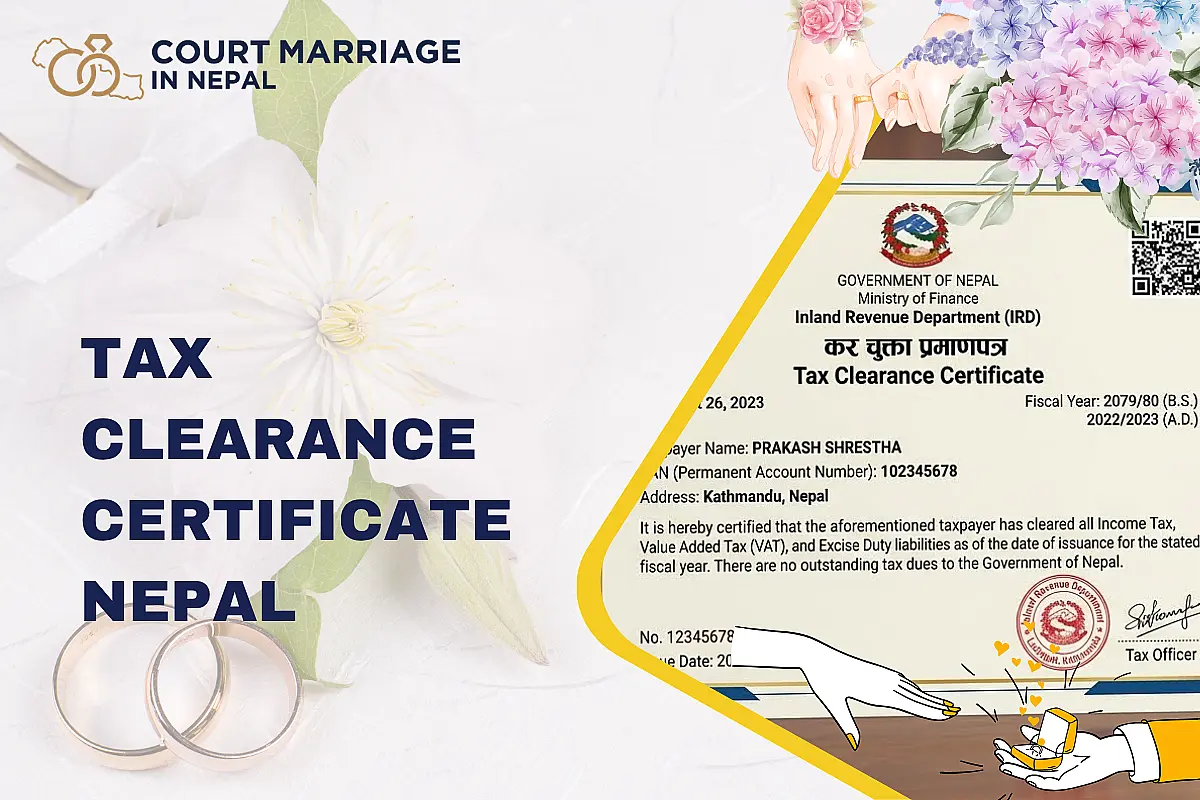
A tax clearance certificate (कर चुक्ता प्रमाणपत्र) is an official document issued by the Inland Revenue Office confirming that:
- All income tax returns have been filed up to the current fiscal year
- All VAT returns are filed and dues paid (for VAT-registered entities)
- All TDS (Tax Deducted at Source) obligations are met
- No outstanding tax arrears, penalties, or interest remain
| Detail | Information |
|---|---|
| Issuing authority | Inland Revenue Office (IRO) where taxpayer is registered |
| Legal basis | Income Tax Act 2058, Section 104 |
| Format | Official letter on IRD letterhead with stamp and signature |
| Fee | Free of charge (if all taxes are cleared) |
| Validity | Typically valid until end of current fiscal year (Ashad end / mid-July) |
| Online availability | Available through ird.gov.np taxpayer portal |
When Do You Need a Tax Clearance Certificate?
| Purpose | Who Needs It | Details |
|---|---|---|
| Government tenders and procurement | Any business bidding for government contracts | Mandatory — bids without tax clearance are automatically disqualified |
| Company annual renewal | All registered companies | Required for annual filing at the Office of Company Registrar (OCR) |
| Bank loans and credit | Businesses and individuals | Banks require tax clearance for commercial loan applications |
| Foreign employment | Nepali citizens going for foreign employment | Required by the Department of Foreign Employment in some cases |
| Visa applications | Individuals applying for certain visas | Some embassies and immigration offices request proof of tax compliance |
| Foreign nationals leaving Nepal | Foreigners who earned income in Nepal | Immigration may require tax clearance before departure |
| Business licence renewal | Sole proprietorships, partnerships | District Administration Office may require for annual renewal |
| Import/export licence | Importers and exporters | Customs and trade licensing authorities require it |
| Property transactions | Buyers/sellers of property above threshold | Land revenue office may require for high-value transactions |
How to Get Tax Clearance Certificate Online
- Visit taxpayerportal.ird.gov.np
- Log in with your PAN credentials
- Ensure all returns are filed: income tax, VAT (if applicable), TDS reports
- Ensure all tax dues are paid in full — check your taxpayer ledger for any outstanding amounts
- Navigate to "Tax Clearance Certificate" or "कर चुक्ता प्रमाणपत्र" section
- Submit the application
- If all records are clear, the certificate is generated — download and print
- If there are discrepancies, the system will flag them — resolve before reapplying
Note: Online generation works best for straightforward cases where all returns are filed and payments matched in the system. Complex cases (disputes, adjustments, carry-forwards) may require an in-person visit to the IRO.
How to Get It at the IRO Office (Offline)
- Visit the Inland Revenue Office (IRO) where your PAN is registered
- Submit a written application requesting the tax clearance certificate
- Attach copies of filed returns and tax payment vouchers
- IRO officer verifies your account — checks all returns, payments, and outstanding dues
- If all clear: certificate issued — typically 1–3 working days
- If outstanding dues found: pay the dues first, then reapply
Documents Required
| Document | Details |
|---|---|
| PAN certificate | Copy of your PAN registration |
| Filed income tax returns | All returns up to the current fiscal year |
| VAT returns (if applicable) | Monthly VAT returns — all filed and paid |
| TDS deposit vouchers | Proof of TDS payments made to the government |
| Tax payment receipts | Bank vouchers showing tax deposits |
| Audit report (if applicable) | For businesses required to have annual audits |
| Application letter | Written request addressed to the IRO (for offline applications) |
| Citizenship/passport | Identity proof of the applicant or authorised person |
Processing Time and Validity
| Aspect | Details |
|---|---|
| Online processing | Instant to 1–2 working days (if all records are clean) |
| Offline processing | 1–7 working days depending on IRO workload and verification |
| Validity | Until the end of the current fiscal year (Ashad end / mid-July) |
| Renewal | File new year's returns and apply again for next fiscal year's certificate |
| Fee | Free — no government fee for issuance |
Fiscal year timing: Nepal's fiscal year runs from Shrawan 1 to Ashad end (mid-July to mid-July). Tax clearance certificates are most commonly needed and issued after the annual return filing deadline. The busiest period at IROs is Chaitra–Baisakh (March–May) when businesses prepare for annual filings and tender season.
Tax Clearance for Foreign Nationals
Foreign nationals who earned income in Nepal — through employment, business, or investment — may need a tax clearance certificate before departing:
| Situation | Tax Clearance Required? | Process |
|---|---|---|
| Foreign employee (work permit holder) | Yes — if earned taxable income | Employer should have deducted TDS; get clearance from employer's IRO |
| Foreign business owner | Yes | File returns and obtain clearance before closing business or departing |
| Foreign investor | Yes — if received taxable income (dividends, capital gains) | File returns through local representative or tax consultant |
| Tourist / short-term visitor | No | No income earned in Nepal = no tax obligation |
| INGO/NGO expatriate staff | Depends on tax treaty and exemptions | Check specific agreement; most need clearance if receiving Nepal-source salary |
Important: Immigration authorities at Tribhuvan International Airport and border checkpoints may request tax clearance from foreign nationals who held work permits. Obtain it before your departure date — last-minute applications cause delays.
Common Problems and Solutions
| Problem | Solution |
|---|---|
| Outstanding tax dues showing on IRD system | Pay all dues at the bank; wait 1–2 days for system update, then reapply |
| Returns not filed for previous years | File all outstanding returns (with applicable penalties) before applying |
| TDS mismatch between employer's filing and your record | Contact employer to reconcile; IRO can verify from employer's TDS reports |
| IRO says pending assessment | If an audit or assessment is in progress, clearance may be conditional or delayed — consult a tax advisor |
| System error online | Visit the IRO in person with hard copies of all payment vouchers and returns |
| Need certificate urgently for tender deadline | Apply 2–3 weeks before deadline; IROs can prioritise if all records are clean |
For income tax details, see income tax in Nepal. For PAN registration, see PAN card registration in Nepal.
Our team assists with tax filing, clearance applications, and IRD compliance for individuals and businesses.
Frequently Asked Questions
A tax clearance certificate (कर चुक्ता प्रमाणपत्र) is an official document from the Inland Revenue Office confirming that a taxpayer has no outstanding tax dues — all income tax, VAT, and TDS obligations are filed and paid. It is issued under the Income Tax Act 2058, Section 104.
Log in to taxpayerportal.ird.gov.np with your PAN credentials. Ensure all returns are filed and taxes paid. Navigate to the tax clearance section and submit your application. If records are clean, the certificate is generated instantly or within 1–2 working days for download.
No. The tax clearance certificate is issued free of charge by the Inland Revenue Office. There is no government fee. The only prerequisite is that all tax obligations — returns and payments — are up to date. If dues are outstanding, pay them first.
The certificate is typically valid until the end of the current fiscal year (Ashad end / mid-July). After the fiscal year changes, you need to file the new year's returns and obtain a fresh certificate. For specific tender requirements, check if the procuring agency specifies a different validity.
Yes — mandatory. All businesses bidding for government procurement contracts must submit a valid tax clearance certificate. Bids without tax clearance are automatically disqualified regardless of the price or technical score. Apply well before the tender deadline.
If you earned taxable income in Nepal (through employment, business, or investment), immigration authorities may require tax clearance before departure. Tourists and visitors who did not earn Nepal-source income do not need it. Obtain clearance before your departure date.
PAN certificate, all filed income tax returns, VAT returns (if applicable), TDS deposit vouchers, tax payment receipts, audit report (if applicable), and a written application letter for offline requests. Citizenship or passport for identity verification.
Online: instant to 1–2 working days if all records are clean. Offline at the IRO: 1–7 working days depending on workload and verification requirements. Complex cases with outstanding assessments or disputes may take longer.
No. You must clear all outstanding tax dues before the certificate can be issued. Pay any arrears, penalties, and interest at the bank, wait 1–2 days for the IRD system to update, and then apply. The IRO will not issue clearance with pending obligations.
Yes. The Office of Company Registrar (OCR) requires a valid tax clearance certificate for annual company renewal and filing. Without it, the company's registration status may be affected. Plan your tax filing schedule to ensure clearance is available before renewal deadlines.
Yes — for business licence renewal at the District Administration Office, government tender participation, and bank loan applications. Sole proprietors file income tax returns under their personal PAN and obtain clearance from their registered IRO.
Contact your employer or the party that deducted TDS to reconcile. They need to file corrected TDS reports with the IRO. You can also visit the IRO with your TDS certificates (Form 15) and payment vouchers for manual verification and correction.
Yes. An authorised representative — accountant, tax consultant, or lawyer — can apply on your behalf with a power of attorney or authorisation letter. For online applications, they need your PAN login credentials. For offline, they need the signed authorisation letter.
Yes — most banks in Nepal require a valid tax clearance certificate for commercial and business loan applications. Some banks also request it for large personal loans. It demonstrates that the borrower is tax-compliant, reducing the bank's risk assessment.
Apply after filing your annual income tax return — typically after the filing deadline in Poush (December–January) for the previous fiscal year. Avoid peak season (Chaitra–Baisakh / March–May) when IROs are busiest. For tender purposes, apply 2–3 weeks before the deadline.
Court Marriage in Nepal Pvt. Ltd. is Nepal's first registered law firm for court marriage services. Since 2016, our Nepal Bar Council-registered advocates have helped 2,000+ couples from 50+ countries with marriage registration, document preparation, and legal consultation. Whether you are a Nepali citizen or a foreign national, contact us today for confidential legal assistance.