Table of Contents
- Is It Legal for Two Foreigners to Marry in Nepal?
- Why Do Foreign Couples Choose Nepal?
- Legal Requirements Under Civil Code 2074
- The 15-Day Residency Rule — For Both Partners
- Documents Required — Both Partners
- Embassy NOC: Getting Documents from Two Embassies
- Step-by-Step Process at the District Court
- After the Marriage: Authentication for International Use
- Common Nationality Combinations We Handle
- Marriage Visa After the Wedding
- Mistakes Foreign Couples Make
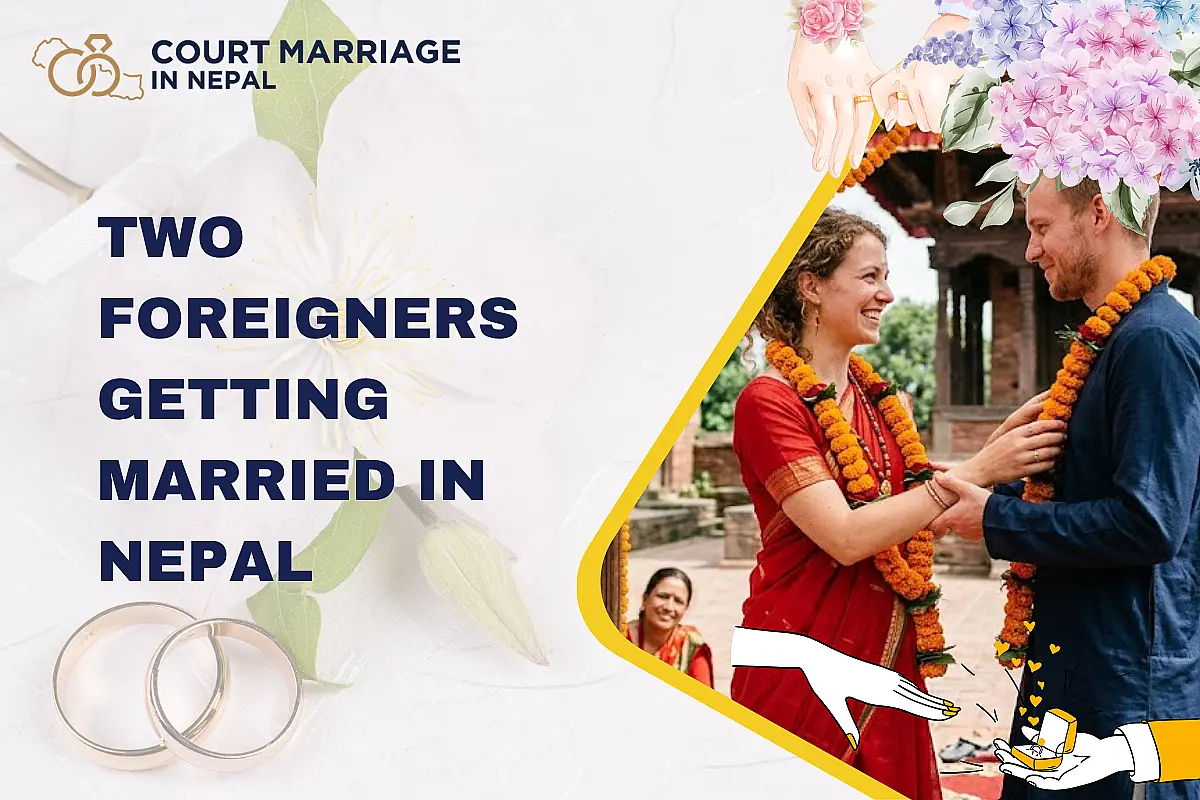
Every year, hundreds of international couples — where neither partner is a Nepali citizen — travel to Nepal specifically to get married. The question we hear most often is straightforward: can two foreigners actually get married in Nepal? The answer is yes. The Muluki Civil Code 2074 does not restrict marriage by nationality. Two foreign nationals from any country can register a legally valid court marriage in Nepal through the District Court. However, when both partners are foreign, the documentation requirements are doubled — both embassies must issue separate NOCs, both partners must complete the 15-day residency requirement, and both sets of documents must be translated and notarised. This guide covers the exact process for an all-foreign couple.
Two foreigners getting married in Nepal is fully legal under Part 3 (Sections 67–84) of the Civil Code 2074. Both partners must be at least 20 years old, unmarried, and give free consent. Each partner needs a passport, valid Nepal visa, embassy NOC or affidavit of eligibility, and single status certificate. Both must complete 15 consecutive days of stay in Nepal before filing the application at the District Court.
Trusted by 2,000+ couples from 50+ countries since 2016.
Planning to marry in Nepal as a foreign couple? Talk to us →
Is It Legal for Two Foreigners to Marry in Nepal?
Yes — without any ambiguity. Section 69 of the Muluki Civil Code 2074 grants every person the freedom to marry according to their own wishes, subject to the legal conditions in Section 70. The law does not require either party to be a Nepali citizen. Whether you are an American marrying a German, a Japanese citizen marrying an Australian, or any other combination of nationalities — Nepal's courts will register your marriage.
In practice, our firm has handled marriages between couples from more than 50 different nationality combinations. The District Court treats foreign-foreign marriages the same as foreigner-Nepali marriages, with one key difference: both partners must provide embassy-issued documents rather than just one.
Why Do Foreign Couples Choose Nepal?
Nepal has become a preferred destination for international couples for several practical reasons:
- No nationality restrictions — unlike countries that require at least one partner to be a citizen or resident
- Faster process — the entire marriage can be completed within 17–20 days, including the mandatory residency period
- International validity — Nepal-issued marriage certificates are recognised worldwide when properly authenticated through the MOFA-embassy legalisation chain
- Affordable compared to Western countries — court fees and legal assistance in Nepal are significantly lower than in the USA, UK, Australia, or Europe
- Tourist visa is sufficient — no special marriage visa is required to file the application
- Simple legal framework — the Civil Code 2074 has clear, straightforward requirements with no complex residency prerequisites beyond the 15-day rule
Common scenario: Couples from countries where inter-faith or inter-cultural marriages face bureaucratic hurdles often choose Nepal because the process is purely civil and does not require religious ceremonies.
Legal Requirements Under Civil Code 2074
Section 70 of the Civil Code defines four mandatory conditions that apply to every marriage — including marriages between two foreigners:
| # | Condition | What It Means for Foreign Couples |
|---|---|---|
| 1 | Free Consent | Both partners must give voluntary consent. Consent obtained through force, fraud, or while of unsound mind is invalid (Section 72) |
| 2 | Minimum Age: 20 Years | Both must have completed 20 years. Even if your home country allows marriage at 18, Nepal requires 20 — no exceptions |
| 3 | Unmarried Status | Neither party can have an existing, undissolved marriage. Divorced persons must provide a finalised divorce decree |
| 4 | No Prohibited Kinship | Marriage is prohibited within certain degrees of family relationship |
Additional requirement for foreigners: Both partners must also comply with the marriage laws of their respective home countries. A translated copy of the relevant marriage law from each country must be submitted to the court.
The 15-Day Residency Rule — For Both Partners
This is the most important practical requirement. Before filing a court marriage application, both foreign partners must complete 15 consecutive days of continuous stay in Nepal. This is non-negotiable.
| Detail | Requirement |
|---|---|
| Duration | 15 consecutive days — no breaks |
| Proof | Passport arrival stamp. Both partners' stamps are checked |
| Can you leave Nepal? | No. Leaving resets the 15-day count |
| Must both arrive together? | No. But the 15-day period is counted from the date the later-arriving partner enters Nepal |
| What to do during the wait? | Obtain embassy NOCs, translate documents, get Ward Office certificates, arrange witnesses |
Pro tip from our practice: If one partner arrives earlier, they can begin their document preparation while waiting for the other. However, the court application can only be filed after both partners have completed 15 days.
Documents Required — Both Partners
When both parties are foreign nationals, the documentation requirement is essentially doubled. Each partner must provide their own set of documents independently.
Documents Each Partner Must Provide
| # | Document | Details |
|---|---|---|
| 1 | Original passport | Must have 6+ months remaining validity. Notarised copy also required |
| 2 | Valid Nepal visa | Tourist visa is sufficient. Both partners need their own |
| 3 | Embassy NOC or Affidavit of Eligibility | From your own country's embassy in Kathmandu. Must be translated to Nepali and notarised |
| 4 | Single status certificate | From your home country, apostilled or legalised, translated to Nepali |
| 5 | Birth certificate | Translated to Nepali and notarised |
| 6 | Marriage law of home country | Translated to English and Nepali. Each partner provides their country's law |
| 7 | Proof of 15-day stay | Passport arrival stamp serves as evidence |
| 8 | Temporary residence certificate | From the local Ward Office where you are staying in Nepal |
| 9 | Passport-size photographs | 4 recent photographs each |
| 10 | Divorce decree (if previously married) | Translated, apostilled, and notarised |
Critical difference from foreigner-Nepali marriages: In a Nepali-foreigner marriage, only the foreign partner needs embassy documents. In a foreign-foreign marriage, both partners must separately obtain their embassy NOCs, single status certificates, and translated marriage laws. This doubles the document preparation time.
Additional Documents for the Court
- Joint petition (mutual application) — signed by both partners
- Two witnesses — with valid Nepali citizenship or passport. Witnesses must be present at the court hearing
- Marriage registration application form — obtained from the District Court
Embassy NOC: Getting Documents from Two Embassies
The No Objection Certificate (NOC) is the single most critical document — and for a foreign couple, you need one from each partner's embassy. Processing times and document names vary by country:
| Country | Document Name | Processing Time |
|---|---|---|
| USA | Affidavit of Eligibility to Marry | Same day (walk-in at US Embassy) |
| UK | Certificate of No Impediment | 7–14 days |
| Australia | Certificate of No Impediment to Marriage | 5–10 days |
| Germany | Ehefähigkeitszeugnis | 3–4 weeks |
| France | Certificat de Capacité Matrimoniale | 2–3 weeks |
| India | NOC from Indian Embassy | 3–5 days |
| Japan | Certificate of Legal Capacity to Contract Marriage | 1–2 weeks |
| South Korea | Certificate of Eligibility for Marriage | 1–2 weeks |
Planning tip: When partners are from two different countries, start the NOC process simultaneously. If one embassy takes longer (e.g., Germany at 3–4 weeks), submit that application first. Coordinate with your lawyer to ensure both NOCs are ready before the 15-day period ends.
What If Your Embassy Does Not Issue an NOC?
Some countries do not issue NOCs. In those cases, an affidavit of single status — a sworn statement that you are unmarried and legally free to marry — can serve as a substitute. The affidavit must be notarised by the embassy or by a notary in your home country and then authenticated for use in Nepal.
Step-by-Step Process at the District Court
| Phase | Action | Timeline |
|---|---|---|
| Days 1–15 | Mandatory residency period. Both partners arrive in Nepal and stay continuously for 15 days. During this time: apply for embassy NOCs (both partners), get all documents translated and notarised, obtain Ward Office temporary residence certificates (both partners), arrange two witnesses | 15 days |
| Day 16 | File application at District Court. Submit joint petition with all documents from both partners. Court clerk reviews and verifies paperwork. If any document is missing, you will be asked to return | 1 day |
| Day 17 | Court hearing. Both partners and two witnesses appear before the judge. Both partners sign the Deed of Consent to Marriage. Judge verifies requirements and grants approval | 1 day |
| Day 18–20 | Marriage certificate issued. The District Court issues the official marriage certificate in Nepali. You then obtain an English translation and begin the authentication chain | 1–3 days |
Total time in Nepal: Plan for 18–22 days. The 15-day residency is fixed. Add 2–3 days for court proceedings and 1–3 days for certificate authentication.
After the Marriage: Authentication for International Use
Your Nepali marriage certificate needs to be authenticated before it will be accepted in your home countries. Since both partners are foreign, you may need two separate authentication chains — one for each country.
The Authentication Chain
| Step | Action | Where |
|---|---|---|
| 1 | Certified translation to English (if needed) | Licensed translator in Nepal |
| 2 | Notarisation | Licensed notary in Nepal |
| 3 | MOFA attestation — Ministry of Foreign Affairs | MOFA office, Kathmandu |
| 4 | Embassy legalisation | Your country's embassy in Kathmandu |
Important: Nepal is not a member of the Hague Apostille Convention. This means that an apostille stamp alone is not sufficient. You must complete the full legalisation chain: Notary → MOFA → Embassy. For notary, MOFA attestation, and embassy legalisation services, our sister firm handles the entire chain.
If partners are from two different countries, the certificate may need to be legalised separately at each embassy. For example, an American-German couple would need the certificate legalised at both the US Embassy and the German Embassy.
Common Nationality Combinations We Handle
Based on our experience since 2016, these are the most common foreign-foreign couples who marry in Nepal:
| Couple Type | Key Consideration |
|---|---|
| American + European | US Embassy issues same-day affidavit. European embassy may take 1–3 weeks. Start the European NOC first |
| Indian + Pakistani | Both embassies are in Kathmandu. Politically sensitive — expect additional scrutiny. Both countries require separate authentication |
| East Asian + Western | Japanese, Korean, and Chinese embassies have specific requirements. Allow extra time for translation between three languages |
| Two European nationals | EU citizens sometimes assume mutual recognition — they still need separate NOCs from each embassy |
| African + Asian | Some African countries have no embassy in Nepal. Use a sworn affidavit from home country, apostilled and authenticated |
Marriage Visa After the Wedding
After the court marriage, a foreign spouse married to another foreigner does not automatically receive a different visa category. Both partners remain on their tourist visas. However, if one partner later sponsors the other for immigration to their home country, the Nepali marriage certificate — once authenticated — serves as the primary evidence of marriage.
If either partner plans to stay in Nepal long-term, they can apply for a visa extension. Nepal does not offer permanent residency for foreign-foreign married couples, but tourist visas can be extended up to 150 days per calendar year.
Mistakes Foreign Couples Make
From our practice handling hundreds of foreign-couple marriages, these are the most common errors:
- Arriving at different times and not coordinating the 15-day count — the count starts from the later arrival, not the earlier one
- Assuming one NOC covers both partners — each partner needs their own NOC from their own embassy
- Not translating documents to Nepali — English-only documents are rejected by the court
- Forgetting the marriage law requirement — each partner must submit a translated copy of their country's marriage law
- Leaving Nepal before authentication is complete — the MOFA and embassy legalisation steps must be done in Nepal
- Not bringing witnesses — two witnesses with valid ID are mandatory at the court hearing
Two foreign nationals planning to marry in Nepal? We have helped couples from 50+ countries navigate the dual-embassy documentation process.
Frequently Asked Questions
Yes. The Muluki Civil Code 2074 does not restrict marriage by nationality. Two foreign nationals of any country can register a court marriage at the District Court in Nepal, provided both meet the legal requirements under Section 70.
Each partner needs an original passport with 6+ months validity, valid Nepal visa, embassy NOC or affidavit of eligibility, single status certificate, birth certificate, translated marriage law of their home country, Ward Office temporary residence certificate, and 4 passport-size photographs.
Yes. Both partners must complete 15 consecutive days of continuous stay in Nepal before filing the court marriage application. The 15-day count starts from the date the later-arriving partner enters Nepal.
Plan for 18–22 days total. The mandatory 15-day residency period is fixed, followed by 2–3 days for the court application, hearing, and marriage certificate issuance, plus 1–3 days for document authentication.
Yes. Each partner must obtain their own No Objection Certificate or equivalent document from their own country's embassy in Kathmandu. One NOC does not cover both partners — each embassy issues documents only for its own citizens.
If your embassy does not issue NOCs, a sworn affidavit of single status can serve as an alternative. The affidavit must be notarised by the embassy or obtained from your home country and authenticated for use in Nepal.
Yes. Both foreign partners can marry on a standard tourist visa. No special marriage visa is required before the wedding. Tourist visas can be obtained on arrival or from a Nepali embassy in your home country.
Both partners must have completed 20 years of age. This applies even if your home country allows marriage at 18. Nepal's minimum marriage age is strictly enforced at 20 with no exceptions.
Yes, in most countries. Nepal marriage certificates are recognised internationally when properly authenticated through the legalisation chain: certified translation, notarisation, MOFA attestation, and embassy legalisation. Check with your home country's authorities for specific requirements.
Nepal made history by registering its first same-sex marriage in 2023. Same-sex couples, including foreign nationals, may be eligible for marriage registration. Consult a lawyer for the latest legal position as implementation is still evolving.
The earlier-arriving partner can begin document preparation, but the 15-day mandatory residency period is counted from the date the later-arriving partner enters Nepal. The court application can only be filed after both have completed 15 days.
Yes. Two witnesses with valid identification (Nepali citizenship certificate or passport) must appear at the District Court during the hearing. Your lawyer can help arrange witnesses if you do not know anyone in Nepal.
Yes. Many foreign couples combine the legal court marriage with a separate celebration or destination wedding in Nepal. The court process is the legal registration; you are free to hold any ceremony you wish separately.
If partners are from different countries, the certificate may need to be legalised at each partner's embassy separately. Nepal is not a Hague Apostille Convention member, so the full legalisation chain (Notary → MOFA → Embassy) is required for each country.
Nepal is significantly more affordable than marrying in Western countries. Court fees, document translation, notarisation, and legal assistance combined are a fraction of what you would pay in the USA, UK, or Europe. Contact us for an accurate quote based on your nationalities.
Court Marriage in Nepal Pvt. Ltd. is Nepal's first registered law firm for court marriage services. Since 2016, our Nepal Bar Council-registered advocates have helped 2,000+ couples from 50+ countries with marriage registration, document preparation, and legal consultation. Whether you are a Nepali citizen or a foreign national, contact us today for confidential legal assistance.