Table of Contents
- Legal Framework for Vital Registration in Nepal
- Types of Vital Events Registered in Nepal
- Birth Registration in Nepal
- Death Registration in Nepal
- Marriage Registration Under Vital Registration
- Divorce Registration
- Migration Registration
- Where to Register Vital Events
- Fees for Vital Registration in Nepal
- Late Registration and Penalties
- Importance of Vital Registration
- Digital Vital Registration System in Nepal
- Common Challenges and How to Overcome Them
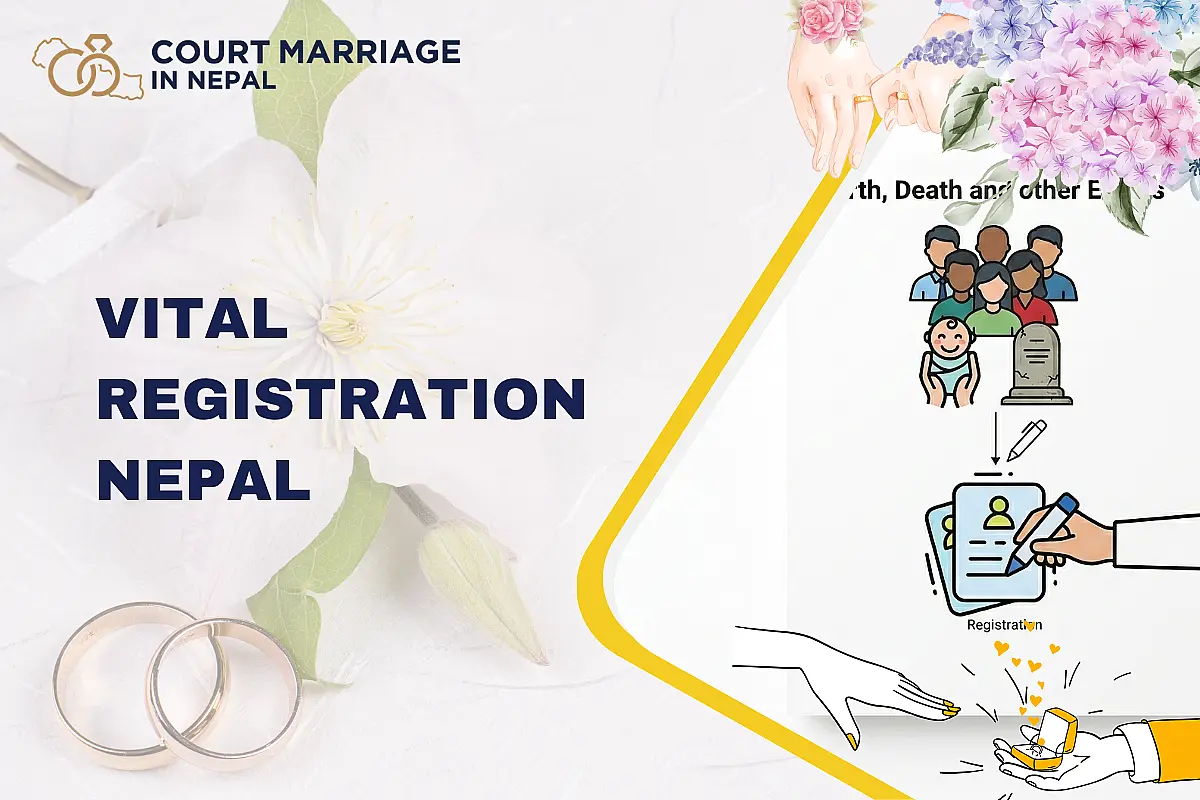
Vital registration in Nepal refers to the compulsory recording of major life events — birth, death, marriage, divorce, and migration — at the local government level. Governed primarily by the Birth, Death and Other Personal Events (Registration) Act 2033 (1976) and operationalized through the Local Government Operation Act 2074 (2017), vital registration is a fundamental government service that establishes legal proof of personal events throughout a person's lifetime.
As of April 2026 (2083 BS), vital registration in Nepal is managed by local-level governments — municipalities (nagarpalika) and rural municipalities (gaunpalika) — which serve as the official registrars. Whether you need to register a newborn child, record a death, or document a court marriage in Nepal, understanding the vital registration system is essential for accessing government services, claiming legal rights, and obtaining identity documents.
Vital registration in Nepal is the mandatory recording of birth, death, marriage, divorce, and migration events at the local government office under the Birth, Death and Other Personal Events (Registration) Act 2033. Registration must occur within 35 days of the event. As of 2083 BS (2026 AD), local municipalities and rural municipalities serve as the registering authority, and failure to register can result in fines and loss of access to citizenship, property, and other legal rights.
Trusted by 2,000+ couples from 50+ countries since 2016.
Speak with a court marriage lawyer today →
Legal Framework for Vital Registration in Nepal
Nepal's vital registration system operates under several interconnected laws that define what events must be registered, who is responsible, and the legal consequences of non-registration.
Birth, Death and Other Personal Events (Registration) Act 2033 (1976)
This is the primary legislation governing vital registration in Nepal. The Act mandates the registration of five categories of personal events: birth, death, marriage, divorce, and migration. Under Section 4, registration must be completed within 35 days of the event occurring. The Act designates the local registrar (now the ward secretary at the local government level) as the responsible authority for maintaining vital event registers.
Birth, Death and Other Personal Events (Registration) Rules 2034 (1977)
These rules prescribe the forms, procedures, and registers to be used for recording vital events. They outline the specific information required for each type of event and the format of certificates issued upon registration.
Local Government Operation Act 2074 (2017)
Following Nepal's transition to a federal structure, the Local Government Operation Act 2074 transferred the responsibility of vital event registration to local-level governments. Under Schedule 8 of this Act, municipalities and rural municipalities are responsible for the registration and certification of births, deaths, marriages, divorces, and migration events within their jurisdictions. This Act effectively made local governments the primary registrars.
National Civil (Code) Act 2074 (2017)
The National Civil Code 2074 reinforces vital registration by requiring that marriages be registered at the local government office to be legally recognized. Section 70 of the Code states that a marriage must be registered within 35 days for it to have full legal standing. This directly connects marriage registration under the vital registration framework with the broader civil law system.
Types of Vital Events Registered in Nepal
Nepal's vital registration system covers five categories of personal events. Each has specific requirements and procedures.
| Event Type | Registration Deadline | Who Must Report | Key Document Issued |
|---|---|---|---|
| Birth | 35 days from birth | Father, mother, or head of household | Birth certificate |
| Death | 35 days from death | Head of household or nearest relative | Death certificate |
| Marriage | 35 days from marriage | Either spouse or both jointly | Marriage registration certificate |
| Divorce | 35 days from court order | Either former spouse | Divorce registration certificate |
| Migration | 35 days from arrival/departure | Head of migrating household | Migration registration certificate |
The uniform 35-day deadline applies to all event types under Section 4 of the Act 2033. Late registration is still possible but may require additional documentation and is subject to a late registration fee.
Birth Registration in Nepal
Birth registration is the most critical vital event registration, as it forms the basis for obtaining Nepali citizenship, school enrollment, and access to all government services throughout a person's life.
Who Must Register a Birth
Under the Act, the father, mother, or head of the household where the birth occurred is legally responsible for registering the birth. In practice, either parent or a close family member can file the registration at the local ward office.
Required Information for Birth Registration
- Full name of the child (may be added later if not decided at the time of registration)
- Date, time, and place of birth
- Sex of the child
- Names of both parents (including mother's maiden name)
- Permanent address of the parents
- Citizenship certificate numbers of both parents
Documents Required
- Citizenship certificates of both parents (original and copy)
- Hospital birth record or a birth attestation from the health facility
- Marriage certificate of the parents
- Recommendation from the ward if born at home without a health facility record
Birth registration is free of charge when completed within the 35-day window. A birth certificate is issued immediately upon successful registration and is required for school admission, passport application, and eventual citizenship application.
Death Registration in Nepal
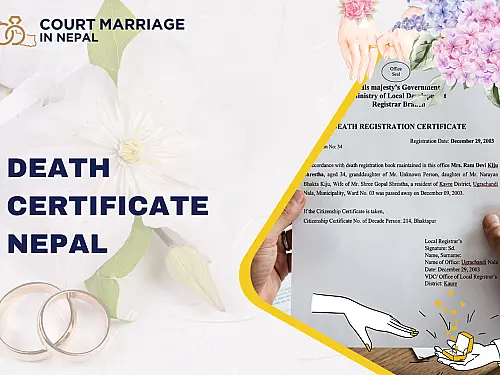
Death registration is legally required under the Act 2033 and serves as official proof that a person has died. This document is essential for property inheritance, insurance claims, pension claims, and updating family records.
Required Information
- Full name of the deceased
- Date, time, and place of death
- Cause of death (if known)
- Age and sex of the deceased
- Citizenship certificate number of the deceased
- Name and relationship of the person reporting the death
Documents Required
- Citizenship certificate of the deceased (original or copy)
- Hospital death certificate or medical certificate of cause of death
- Citizenship certificate of the person reporting the death
- Police report (if death occurred under suspicious circumstances)
The death certificate issued upon registration is required for survivors to claim inheritance rights under the National Civil Code 2074, process life insurance claims, and access the deceased's bank accounts or property.
Marriage Registration Under Vital Registration
Marriage registration is both a vital event registration under the Act 2033 and a legal requirement under the National Civil Code 2074. Couples who complete a court marriage in Nepal must also ensure the marriage is registered at the local government office.
Registration Process
- Both spouses visit the ward office of either spouse's permanent address
- Submit the marriage registration application form
- Provide citizenship certificates of both spouses
- Provide two witnesses with their citizenship certificates
- Submit passport-size photographs of both spouses
- The ward secretary verifies the documents and registers the marriage
- A marriage registration certificate is issued
For couples who have already obtained a court marriage certificate, the court order serves as the primary document for vital registration of the marriage. The marriage registration certificate issued by the local government is the document recognized for changing names, updating citizenship records, and applying for spousal visas.
Planning a court marriage or need help with marriage registration? Contact our experienced legal team for step-by-step guidance.
Divorce Registration
When a court issues a divorce decree, the divorce must be registered at the local government office as a vital event. This updates the civil status of both former spouses in the official registers.
Requirements for Divorce Registration
- Certified copy of the court divorce decree
- Citizenship certificates of both former spouses
- Original marriage registration certificate
- Application form at the local ward office
The divorce registration certificate is necessary for either spouse to legally remarry. Without this registration, subsequent marriages may face legal challenges. From our experience assisting clients, we have seen cases where failure to register a divorce caused significant delays in processing a second marriage.
Migration Registration
Migration registration records the movement of individuals or families between different local government jurisdictions within Nepal. When a family permanently moves from one municipality to another, the migration must be registered at both the originating and receiving local government offices.
Process
- Obtain a migration certificate (basai sarai) from the originating ward office
- Submit the migration certificate at the receiving ward office within 35 days of arrival
- Update voter registration and other local records at the new location
Migration registration is important because it determines where a person can access local government services, vote in local elections, and claim residency-based entitlements.
Where to Register Vital Events
Since the enactment of the Local Government Operation Act 2074, all vital event registrations are handled at the ward office of the relevant municipality or rural municipality. Nepal has 753 local governments (6 metropolitan cities, 11 sub-metropolitan cities, 276 municipalities, and 460 rural municipalities), each divided into wards.
| Event | Where to Register | Authority |
|---|---|---|
| Birth | Ward office where birth occurred or parents' permanent address | Ward Secretary |
| Death | Ward office of the deceased's permanent address | Ward Secretary |
| Marriage | Ward office of either spouse's permanent address | Ward Secretary |
| Divorce | Ward office where marriage was registered | Ward Secretary |
| Migration | Both originating and receiving ward offices | Ward Secretary |
The ward secretary (ward sachiv) serves as the local registrar and is legally authorized to register events, issue certificates, and maintain the vital registration registers under the Local Government Operation Act 2074.
Fees for Vital Registration in Nepal
Vital event registration fees in Nepal are set by local governments and may vary slightly between municipalities. However, most follow a standard fee structure.
| Service | Typical Fee (NPR) | Notes |
|---|---|---|
| Birth registration (within 35 days) | Free | Constitutional right under Article 16 |
| Death registration (within 35 days) | Free | No charge if within deadline |
| Marriage registration | 100 - 500 | Varies by municipality |
| Divorce registration | 100 - 500 | Varies by municipality |
| Migration registration | 100 - 300 | Varies by municipality |
| Late registration (any event) | 200 - 1,000 | Increases with delay period |
| Duplicate/replacement certificate | 100 - 500 | Requires affidavit for lost certificates |
Birth and death registrations within the 35-day window are free of charge as a matter of policy in most municipalities, aligned with Nepal's commitment to universal vital registration.
Late Registration and Penalties
While the law mandates registration within 35 days, late registration is common in Nepal, particularly in rural areas. The Act 2033 provides for late registration but with additional requirements.
Late Registration Process
- After 35 days but within 1 year: Registration is possible with a late fee and a recommendation letter from the ward chairperson
- After 1 year: Requires additional supporting documents such as school records, hospital records, or sworn statements from witnesses. An affidavit may be required
- Adult birth registration: Adults who were never registered at birth must provide a citizenship certificate, school leaving certificate, and an affidavit from two witnesses
Under Section 6 of the Act 2033, the registrar may impose a fine of up to NPR 200 for late registration beyond 35 days. While this fine is relatively small, the real consequence of non-registration is the inability to access essential services and documents.
Importance of Vital Registration
Vital registration is not merely a bureaucratic formality. It has direct legal and practical consequences for individuals and families in Nepal.
- Citizenship application: A birth certificate is the primary document for applying for Nepali citizenship at age 16
- School enrollment: Schools require a birth certificate for student admission
- Passport application: Birth registration is a prerequisite for obtaining a Nepali passport
- Property rights: Death registration is required to initiate inheritance proceedings under the National Civil Code 2074
- Insurance and pension claims: Death certificates are mandatory for life insurance payouts and survivor pension claims
- Remarriage: Divorce registration is required before either spouse can legally remarry
- Voter registration: Migration registration determines local voting eligibility
- Document attestation: Vital registration certificates may need apostille or attestation for use abroad
Married couples should be particularly aware that marriage registration through the vital registration system is the document most commonly requested for visa applications, spousal sponsorship, and name change processes. A court marriage certificate alone may not suffice without the corresponding vital registration entry.
Digital Vital Registration System in Nepal
Nepal has been progressively digitizing its vital registration system since 2018. The government, with support from development partners, has rolled out electronic vital registration and statistics (e-CRVS) systems in many municipalities across the country.
Key Features of the Digital System
- Online registration: Some municipalities now accept vital event registrations through digital portals
- Centralized database: Event records are stored in a national database, reducing data loss risks
- Unique identification: Each registered event generates a unique registration number linked to the National ID system
- Inter-municipality access: Digital records enable verification across different local governments
As of 2083 BS (2026 AD), the digital system is operational in most urban municipalities but is still being expanded to rural areas. The Department of National ID and Civil Registration (DoNIDCR) oversees the national vital registration database.
Common Challenges and How to Overcome Them
Based on our experience assisting clients with legal documentation across Nepal, these are the most common challenges people face with vital registration.
- Name discrepancies: Spelling differences between the birth certificate and citizenship certificate can cause problems. Always verify that names are consistent across all documents
- Missing birth registration for adults: Many adults born in rural areas before 2000 were never registered. They must now complete late registration with supporting documents before applying for citizenship or passports
- Cross-district registration: When an event occurs in a different district than the person's permanent address, confusion about which office handles registration is common. The event can generally be registered at either location
- Lost certificates: If a vital registration certificate is lost, apply for a duplicate at the issuing ward office with an affidavit declaring the loss
- Delayed marriage registration after court marriage: Some couples complete their court marriage but forget to register it as a vital event at the ward office. This can create problems when applying for passports or visas that require the ward-level registration certificate
Need help with vital registration, document corrections, or legal documentation? Contact our legal team for professional assistance with any registration matter in Nepal.
Frequently Asked Questions
Vital registration in Nepal is the mandatory recording of birth, death, marriage, divorce, and migration events at the local government ward office under the Birth, Death and Other Personal Events (Registration) Act 2033 (1976).
All vital events must be registered within 35 days of occurrence under Section 4 of the Act 2033. Late registration is possible but requires additional documentation and may incur a fine of up to NPR 200. Birth and death registration within the 35-day deadline is free of charge in most municipalities.
Registration is done at the ward office of the relevant municipality or rural municipality. For births, register at the ward where the birth occurred or the parents' permanent address. For marriages, register at the ward of either spouse's permanent address. The ward secretary serves as the official local registrar under the Local Government Operation Act 2074.
Yes. Birth registration is free when completed within the 35-day deadline.
You need the citizenship certificates of both parents (original and copy), the hospital birth record or health facility attestation, the parents' marriage certificate, and the child's details including name, date, and place of birth. For home births without hospital records, a recommendation from the ward chairperson is required.
Yes. Late birth registration is allowed but requires additional documents such as school records, hospital records, or sworn witness statements. A late fee may apply. Adults who were never registered at birth need a citizenship certificate, school leaving certificate, and an affidavit from two witnesses to complete the registration.
Under Section 6 of the Birth, Death and Other Personal Events (Registration) Act 2033, a fine of up to NPR 200 can be imposed for late registration. However, the practical consequence is far greater — without registration, you cannot obtain essential documents like citizenship certificates, passports, or inheritance rights.
Yes. After completing a court marriage in Nepal, you should register the marriage at your local ward office as a vital event. The court marriage certificate is used as the primary document for ward-level registration. The ward-issued marriage registration certificate is commonly required for visa applications, name changes, and spousal sponsorship.
Report the death at the ward office of the deceased's permanent address within 35 days. Submit the deceased's citizenship certificate, a hospital or medical death certificate, and the citizenship certificate of the reporting person. The ward secretary issues the death certificate upon registration, which is essential for inheritance and insurance claims.
Migration registration (basai sarai darta) records the permanent movement of a person or family from one municipality to another. You must obtain a migration certificate from the originating ward office and register at the receiving ward office within 35 days. This updates your voter registration and local service access.
The Birth, Death and Other Personal Events (Registration) Act 2033 (1976) is the primary law. It is supported by the Registration Rules 2034, the Local Government Operation Act 2074, and the National Civil Code 2074, which together define registration procedures, authorities, and legal requirements for all vital events.
Some municipalities now offer digital vital event registration through the electronic civil registration and vital statistics (e-CRVS) system. The Department of National ID and Civil Registration oversees the digital system, which is operational in most urban areas but still expanding to rural municipalities as of 2026.
A birth certificate from vital registration is required for school enrollment, citizenship application at age 16, passport issuance, and accessing all government services. Without birth registration, a person essentially lacks official legal identity in Nepal.
Apply for a duplicate certificate at the ward office that originally issued it. You need to submit an affidavit declaring the loss, your citizenship certificate, and pay the duplicate fee (typically NPR 100 to 500). If records were digitized, the process is faster as the original data is retrievable from the system.
Yes. After a court issues a divorce decree, the divorce must be registered at the local ward office as a vital event within 35 days. Divorce registration updates the civil status of both former spouses and is legally required before either person can remarry under the National Civil Code 2074.
Court Marriage in Nepal Pvt. Ltd. is Nepal's first registered law firm for court marriage services. Since 2016, our Nepal Bar Council-registered advocates have helped 2,000+ couples from 50+ countries with marriage registration, document preparation, and legal consultation. Whether you are a Nepali citizen or a foreign national, contact us today for confidential legal assistance.